Wednesday, 7 September 2022

YouTube updates Masthead ad requirements to allow sports betting

YouTube is now allowing sports betting ads to serve on the masthead as long as the ads comply with the related gambling and games policy.

Recent masthead updates. Additional masthead updates were released in June for alcohol and prescription drugs. Full-day masthead reservations were discontinued and replaces with more targeted options. The new CPM option allows mastheads to be more accessible to a broader market of advertisers. 

Read the announcement. You can read the announcement from Google here. Google’s guidelines for advertising sports and gambling can also be found here.

Why we care. Advertisers who run YouTube campaigns for sports and gambling can now have their ads in the most prominent ad space, so long as they comply with YouTube policies.

The post YouTube updates Masthead ad requirements to allow sports betting appeared first on Search Engine Land.


via Search Engine Land https://ift.tt/L54FJ9Z

Google has updated their Invalid Traffic policies

Google has just announced an update to their Invalid Traffic guidelines.

What is Invalid Traffic. Invalid Traffic is “any activity that doesn’t come from a real user with genuine interest. It can include accidental clicks caused by intrusive ad implementations, fraudulent clicking by competing advertisers, advertising botnets and more.”

What Google says. The policy update was announced on Twitter by Google Policy Transparency staff member Aurora Morales.

Invalid Traffic examples. In their policy update, Google provides 12 examples of Invalid Traffic but adds that this is not an exhaustive list.

  • Accidental clicks
  • Ad hiding
  • Ad stacking
  • Clickjacking
  • Pop-under ad

Why we care. The new policy updates affect Google AdSense, Ads Manager, and mobile apps. Advertisers who consistently see increased clicks, lower CTR, or suspect that their ads are being clicked by bots or competitors may see their ad spend decrease as Google works to stop the fraud and lessen the costs to account holders.

The post Google has updated their Invalid Traffic policies appeared first on Search Engine Land.


via Search Engine Land https://ift.tt/UzBTC3v

Registration is open for SMX Next… grab your free pass now!

The staggering amount of global change in the last 24 months has presented search marketers with an unrivaled amount of challenges… and opportunities. Are you prepared for the impending shift to Google Analytics 4? What do AI and ML mean for content – today and in the future? Is now the right time to dive into Performance Max campaigns?

Explore these and more critical issues and the actionable tactics you need to tackle them head-on at SMX Next, online November 15-16… for FREE.

Your free SMX pass packs a ton of value:

  • 100% online. Tune in from no matter where you are – cubicle, coffee shop, couch – wherever. No plane ticket, hotel room, or travel risks required.
  • 100% free. You don’t have to juggle financial priorities, justify registration fees, or bother with expense reports.
  • In-depth live Q&A. Tap directly into some of the brightest minds in search, ask them your questions, and get real-time answers during Overtime!
  • Actionable tactics. Walk away with reliable, actionable, brand-safe insights you can immediately apply to your campaigns to drive measurable results.
  • Instant on-demand access. Can’t attend live? On-demand replay is included with your free pass so you won’t miss a second of the action.

The Search Engine Land experts are hard at work programming the agenda… stay tuned for more details. In the meantime, secure your free registration now!

The post Registration is open for SMX Next… grab your free pass now! appeared first on Search Engine Land.


via Search Engine Land https://ift.tt/UAzRhck

Optimizing content for search: A 4-step guide

SEO and content are both powerful on their own.

But it’s the combination of the two where you see the best results.

It isn’t just optimizing your content for search but instead, taking a different approach and creating a single SEO content strategy.

When we talk about optimizing content for search, we often highlight what you’d expect.

  • Choose a keyword.
  • Use that keyword in your
    • Title tag.
    • Meta description.
    • Header tags.
    • Copy.
    • Image file name.

That will get you some results. And a few years ago, that was truly all you needed to do.

But today, you need to do way more to get better results.

You need to intertwine SEO and content so they’re one in your strategy.

How to get better results from your content

Start by thinking about your audience. 

  • Who are you writing for? 
  • What are they interested in? 
  • What questions do they have that you can answer? 
  • What terms do they use for the topics that you write about? 
  • Are they the same words you use, or are they different terms? 

If they’re different, you need to take note of that and speak to them in their language by using the words they use, even if they’re not your brand terms. 

Everything you create should be designed to help your audience. If you’re not providing valuable content, they will not come back again and read more. 

Your goal with all content development is to become a trusted resource for your audience. When users know they can get the answers they need from you, they’re more likely to return and share your content with someone else, which helps your business grow.

How to use SEO and content together 

Once you’ve clarified who you’re creating this content piece for, it’s time to start brainstorming.

You can:

  • Brainstorm ideas.
  • Check the SERPs for terms that might interest your audience and ensure your content aligns with the search intent.
  • Use your favorite SEO keyword research tool for idea generation. 

Search for keywords that are related to your core products or services. Search for questions your ideal customers ask regularly. Often, questions are a fantastic starting point for content development.

Step 1: Research topic

To do your research, you can use search features and tools such as:

  • Google:
    • Autocomplete
    • Related searches
    • People also ask
  • AnswerThePublic
  • Quora
  • Social media
    • Hashtags
    • Searches
    • Groups

You want to look and see what people are asking about the topics most closely aligned with your business. 

What questions do they have? What information do they need to have before making a decision?

Step 2: Research keywords

Once you have a topic idea based on research, you know people are interested because they’re searching for information online. 

Now it’s time to go back to the keyword research tool and see what keyword you want to target in your content piece. 

Choose the keyword option that provides you with a realistic chance of ranking. It should also tie the closest to your desired topic and products or services.

Step 3: Write

Now, you’re ready to start writing. You have a topic you know people are interested in and searching for. You have a keyword you’ve researched, and you know your website has a good chance of ranking at the top of Google. 

It’s time to create a great piece of content that provides value for your ideal customer. You want to focus on them, their needs and their questions. 

Don’t get fixated on a specific number of words or paragraphs. Instead, focus on providing value, answering questions, and helping them. 

You should have a good idea of your customer’s questions about this topic.

Writing tips

  • No one wants to read big blocks of text. You’ll lose your readers if that’s what you publish. Make sure you’re improving the readability for your audience, adding:
    • Headers (H2s/H3s)
    • Ordered/unordered lists.
    • Images/videos.
    • White space.
  • Don’t write to a specific word count. Write to tell the reader what they need. Help them understand the topic. Anticipate the questions they’re going to have and answer them. 
  • Avoid unnecessary fluff. Don’t set out to use your keyword a specific number of times. When you write to a word count or keyword insertion count, you can end up with content that feels unnatural and will not drive the results you want.
  • Make sure your content is of high quality and follows grammatical rules. Edit it to ensure it’s easy to read and understand. Reading your copy aloud can help you identify keyword stuffing, grammatical errors, and more. It’s an easy way to ensure your copy sounds natural when your audience reads it.
  • Make sure your content is helpful, valuable, thorough (have you answered all of your audience’s questions on this topic?), and ultimately better than the competition’s content if you want to outrank them.

In short, tell the story, provide value, let the piece develop naturally, and you’ll have better content. 

Step 4: Optimize

Now it’s time to optimize your content.

You’ve chosen your keyword, and you want to use that in the following SEO elements.

  • Title tag
  • Meta description
  • Copy
  • Header tags
  • Image file name (format with a hyphen in between words)
  • URL

Be sure to follow SEO best practices when optimizing your content.

You should start to see results as long as you’ve chosen a topic that you know people are interested in, a keyword your website can rank for, written for your customer, and provided value – not fluff.

Optimization tips

  • Link to other relevant content on your website. Providing additional resources for your audience can help them better understand the topic.
  • Refresh your optimization periodically. Optimization is not a one-and-done task; it’s ongoing. You can refresh on a schedule or when you see the opportunity to improve keyword rankings for a piece of content. Sometimes an update and refresh can help an older piece move up in the rankings.

The best content is SEO content

Simply churning out content is not enough to win at SEO today. You need to create helpful content for your audiences. 

Think of it as one unified strategy and use your SEO tools from the beginning, and you’ll get better visibility in the SERPs. Craft a strategy focusing on your audience and their questions first and foremost.

Your content strategy should include topics that tie together, are of interest to your audience and are helpful to your audience. 

Link from one piece to another, providing additional resources and information your audience may want to dig deeper into, and you’ll help your overall SEO content efforts.

The post Optimizing content for search: A 4-step guide appeared first on Search Engine Land.


via Search Engine Land https://ift.tt/9gG6QDF

How to optimize the marketing KPIs moving the needle in e-commerce

In a world with tightening budgets, limited resources and a growing “do more with less” attitude, tracking performance metrics and optimizing them are more important than ever. Marketers, business leaders and other cost-center functions need to be able to show value and ROI on the spend in their programs, which is why meaningful KPI measurement is critical. In order to navigate the ever-changing waters ahead, it’s essential that leaders are laser-focused on the right KPIs for their business goals and needs—not vanity metrics.

“The Marketer’s Ultimate Guide to E-commerce Metrics” not only provides strategies for mapping out the KPIs that matter to your brand, but it also provides practical tips and ideas to optimize for those goals. The actionable recommendations in this guide have been built and tested in today’s e-commerce climate, so you can implement them straight away.

A few of the optimization insights you’ll find in this e-book include:

  • Ways to lift Average Order Value (AOV) by implementing product recommendation testing on product pages.
  • Strategies for boosting Customer Lifetime Value (CLTV) beyond the traditional loyalty rewards program (the e-book includes several dynamic examples).
  • Tactics for improving your Sales Conversion Rate (CVR) by creating a smoother ad-to-website experience and leaning into your CRO solution’s machine learning technology.
  • Methods based on machine learning and artificial intelligence to effectively lift KPIs like shopping cart abandonment rate.

Ready to quit making moves out of the same standard playbook, expecting different results? Start thinking outside the box by downloading The Marketers Ultimate Guide to E-commerce Metrics today and read up on fresh conversion strategies built for 2022 and beyond.


The post How to optimize the marketing KPIs moving the needle in e-commerce appeared first on Search Engine Land.


via Search Engine Land https://ift.tt/wabX6eQ

How to create, analyze and optimize Dynamic Search Ads

Automation poses a risk to job security in nearly every industry. As PPC marketers, algorithm-based tools have changed the face of our job.

While we once spent our workday performing keyword research, writing ad copy and adjusting bids, Google’s machine learning automates tasks for easier account management. But don’t worry, we’re not going to be replaced by robots any time soon! 

A set-it-and-forget-it approach to automation will drain your budget and flood your website with unqualified traffic. A human must partner with machine learning to make this automation successful and guide the algorithms in the right direction.

This is especially true for Dynamic Search Ads (DSAs).

Why dynamic search ads are important

DSAs crawl your website (or certain pages) for keywords – no keyword research is required!

The system dynamically serves relevant landing pages and writes headlines for the ad. From ecommerce to B2B, Dynamic Search Ads are important in any account for three reasons.

Find new keywords

15% of Google searches have never been searched before. When performing keyword research with the Keyword Planner Tool, many keywords won’t appear because they haven’t been entered into the Google search bar yet or the search volume is low. 

Queries are becoming more long-tail and unique. Your current keyword set may not capture terms in how users are searching for them.

Save time

No keyword research or ad copywriting is required for Dynamic Search Ads (except for the description lines). Google automates these tasks for you. 

If messaging changes on your website or a new landing page launches, ad messaging will update, allowing you to focus more time on strategy, analysis and other account optimizations.

Identify gaps

Dynamic Search Ads scour your website and test URLs that wouldn’t normally be leveraged as landing pages. You might be surprised to find that a topic, theme, or page that doesn’t typically get promoted converts well.

Analyzing performance data on various pages can tell you what content, formats or page layouts are resonating and/or converting best. 

Getting started with Dynamic Search Ads

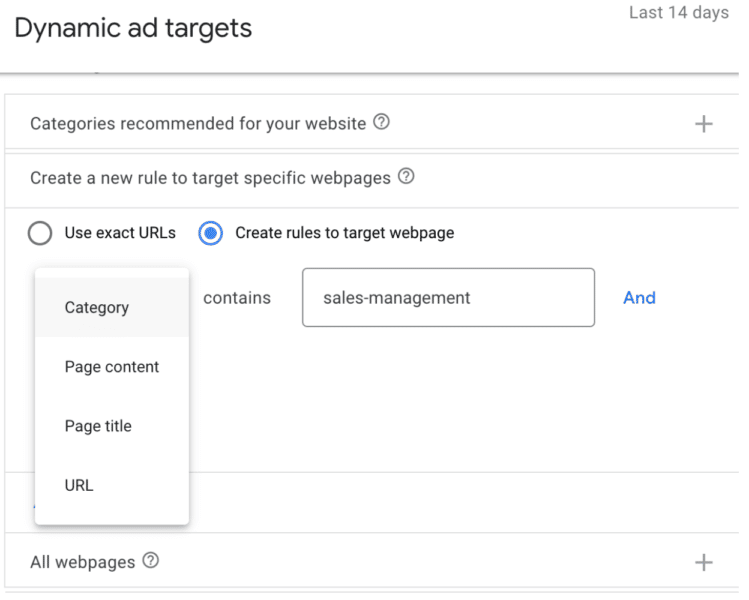
Begin the DSA process by reviewing your entire website and casting a wide net. Options for dynamic ad targets include:

  • Categories recommended for your website include multiple pages with a specific theme, such as product pages, blog topics, etc.
  • Specific webpages based on URL, category, page title or page content logic that you select.
  • All webpages target your entire site.

Exclude obvious sections such as career pages, investor pages and topics that marketing dollars shouldn’t focus on. Giving the system more pages to crawl speeds up the learning process, providing you with more insights to drive optimizations sooner.

Dynamic Search Ads - Add Dynamic Target.

Analyzing the performance of Dynamic Search Ads

Looking at your search term report, if search terms are converting well, ensure that these keywords get bid on all the time by adding them to an existing non-DSA campaign.

Choosing to leave the term in the DSA campaign is fine, but the regular campaign can help control ad copy and bidding.

After you have initial learnings from analyzing your top-performing keywords and landing pages, create ad groups that put similar pages together by theme, topic, product or solution.

In this way, your analysis can go deeper into what’s converting best, and you can eventually pause underperforming ad groups. If ad groups have differing goals, place them in separate campaigns.

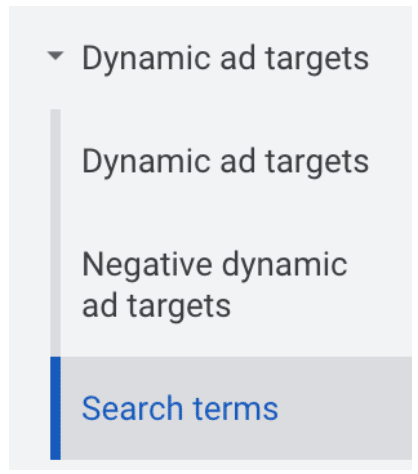
Dynamic Search Ads - Dynamic ad targets.

Controlling ad copy

Lack of control over ad copy can be concerning for any brand, but there are actions we can take to steer the reigns a bit.

Take a look at the search terms report that falls under Dynamic ad targets. This important report shows the search term an ad showed for, the headlines used in ad copy and the landing page served. 

Dynamic Search Ads - Search Terms Report.

If the headlines used in specific ads were unfavorable, you can either update the copy on the landing page or add that landing page as a negative dynamic ad target.

You can also choose only to serve certain landing pages as ad targets. Remember that impression volume may be low if these pages lack lengthy content because DSAs will be limited in the keywords they can pull.

Alternatively, DSAs offer the opportunity to write two description lines. Here, you can mention specific brand messaging, a limited-time offer or any other necessary verbiage that needs to be shown to the user.

Optimizing for quality conversions

Common issues with DSAs are unqualified traffic and low conversion rates/high CPAs. This could be due to poor landing page experience, keyword/audience misalignment, and lack of smart bidding.

If Dynamic Search Ads are underperforming, here are several actions you can take.

Keyword exclusions

Take a look at your search term report, sorted by impressions, to focus on the largest volume keywords first. This will help you to understand where the bulk of your budget is being spent and perhaps wasted.

Dynamic Search Ads - Keyword Exclusions.

Browse the list for irrelevant keywords that dollars should not be spent on. You can exclude unwanted keywords in two ways:

  • Check the box next to the search term and then select Add as negative keyword. 
  • Look for general themes that you might what to exclude. In this example, we see many search terms for “return on investment.” Rather than clicking the checkboxes to exclude these terms individually, save time by adding broad match “return on investment” as a negative keyword to the ad group or campaign.

Landing page exclusions

The same report can identify underperforming landing pages similar to keyword exclusion methodology. If this is the case, check the box within that row and click Add as negative URL.

Consider the user experience. Are there pages that don’t have a strong UX or support the goal of the campaign? For example, if your goal is asset downloads, serving an ungated blog post will almost certainly have a low conversion rate since the page does not offer a downloadable asset or form. As mentioned earlier, ad groups and pages should all have the same goal within a campaign.

Negative dynamic ad targets can be set using exact URLs or rules based on category, page content, page title or URL logic.

Use value-based bidding

When coupled with bidding strategies like Maximize Conversion Value and Maximize Conversion Value with the tROAS option, Dynamic Search Ads are homerun. Setting clear goals for the algorithm to work towards will improve the performance of your campaigns. When the system understands the most valuable conversions, it knows what to strive towards.

Ideally, value-based bidding will be leveraged with offline conversions set as the campaign goal so machine learning can optimize for the most important leads/sales based on back-end data.

Tap into audience targeting

Still not convinced that DSAs are the right fit for your account? Test them out with a valuable first-party audience list.

The audience size needs to be large enough to get substantial impressions. Since the people on this list are important to you, the exposure from serving an impression and/or gaining a click will be valuable even if they do not convert.

Layering audience targeting to your DSA campaign should improve the quality of the traffic and teach algorithms who to go after.

Dynamic search ads and beyond

The future of keywords in PPC marketing is questionable. We can expect that DSAs are just the beginning of phasing out keywords as we know them.

As algorithms advance and machine learning take over more heavy lifting, we should be ready to embrace and test new automated features if it means improving performance. 

Take this as an opportunity to work smarter, not harder. Now is the time to shift focus to strategic thinking, deeper data analyses and providing additional value elsewhere in the account.

The post How to create, analyze and optimize Dynamic Search Ads appeared first on Search Engine Land.


via Search Engine Land https://ift.tt/YJCtx0d

Tuesday, 6 September 2022

Webinar: How to choose whether to build or buy with this CDP checklist

What’s best for you? A CDP out-of-the-box? Building a customer data solution yourself? There’s merit in both options, and this webinar is here to help you narrow down what’s best for your business.

Register today for “How to Decide to Build or Buy: A Customer Data Management Checklist,” presented by Acquia.

The post Webinar: How to choose whether to build or buy with this CDP checklist appeared first on Search Engine Land.


via Search Engine Land https://ift.tt/t5mz9PW