Wednesday, 4 January 2023

Microsoft to add ChatGPT features to Bing Search

Microsoft may be adding OpenAI’s ChatGPT features to Bing Search in the coming months. According to a report by The Information, two sources from the company is saying the company likely will be adding the popular ChatGPT AI question and answer service to Bing, Microsoft’s search engine.

What is ChatGPT. OpenAI-launched chatbot ChatGPT several months ago and it has become incredibly popular across the web. Everyone, not just SEOs, are using it to get answers for homework, for writing essays and to get answers to their queries. Some have called ChatGPT the Google killer, but that may be a stretch.

ChatGPT is a chatbot launched by OpenAI in November 2022. It is built on top of OpenAI’s GPT-3.5 family of large language models, and is fine-tuned with both supervised and reinforcement learning techniques. ChatGPT uses content across the web from before 2021 to teach itself how to answer questions, but when it comes to recent and trending topics, it has difficulty. You can learn more about how it technically works in this blog post.

The report. The report from The Information writes, “Microsoft could soon get a return on its $1 billion investment in OpenAI, creator of the ChatGPT chatbot, which gives humanlike text answers to questions. Microsoft is preparing to launch a version of its Bing search engine that uses the artificial intelligence behind ChatGPT to answer some search queries rather than just showing a list of links, according to two people with direct knowledge of the plans. Microsoft hopes the new feature, which could launch before the end of March, will help it outflank Google, its much bigger search rival.”

There has been a lot of coverage of this report that you can find on Techmeme.

Google in trouble. Honestly, I don’t think Google is in trouble despite reports of “code red” at Google over the AI based Chatbot. Google has pretty advanced AI and machine learning that can likely do exactly what ChatGPT does already or better. In fact, Google’s spam team said they have methods to detect and neutralize AI plagarized scrapped types of content. Plus, we know there are plenty of tools to detect AI generated content, so if AI can detect AI, I wonder how much of a code red it is?

Why we care. With any new search feature, espesially a chatbot, this can change and redirect searcher behavior. As SEOs, SEMs and marketers, understanding searcher behavior and showing up in the places that people are searching is important to drive awareness, traffic and business for you and your clients.

This is very new, but I am sure we all will be watching this space very carefully to make sure we leverage it for clients and stakeholders.

The post Microsoft to add ChatGPT features to Bing Search appeared first on Search Engine Land.


via Search Engine Land https://ift.tt/kNTte0a

4 tips to build a data-centric culture in your agency

As we ring in a new year, among your 2023 goals as an agency may be to level up your data game, deliver excellence to your current clients and stand out to prospects. 

Using the following tips will help you start laying the groundwork to build a culture of data within your organization.

1. Hire expert personnel to guide your strategy

Developing a solid data foundation requires experienced leadership to steer the ship. This person should be responsible for:

  • Defining high-level agency data goals.
  • Laying out a detailed roadmap to accomplish them. 

Many companies are working off piecemeal data pipelines, siloed data and out-of-date infrastructure with no real central ownership. 

A seasoned data pro can come in and wrangle everything into a cohesive data blueprint and determine whether to keep or scrap existing infrastructure and processes moving forward.

Avoid putting these responsibilities on the plate of your ad managers and client service leaders as an afterthought.

When you have experts in the right roles and hand them the key, your agency and clients will see that you are prioritizing your data strategy. 

No matter the size of your company, having dedicated data personnel will result in more efficient processes.

This ultimately supports the work of your marketers, which brings us to the next point.

2. Bridge the gap between the data team and the client services team

While it’s important to have a designated data team, you should consider them as an extension of the client services team rather than a separate department.

The data team’s work should support the client service team’s goals. 

Developing synchronicity between these teams is the key to maximizing the potential of data and demystifying data processes for your whole agency. 

Data education should be an agency-wide initiative. The data team should:

  • Communicate to the client service team what is available and possible from a data standpoint.
  • Offer ongoing cross-training and education to the rest of the team. 

In turn, client services can think creatively about new ways to analyze and present findings to clients to unlock results. 

While ad managers aren’t also expected to be data engineers, understanding data flow and processes will help them think more creatively about how data optimize and deliver deeper insights to clients. 

On the other side, ensuring that your data team has proper marketing education enables them to think about solutions in the correct context.

This keeps them from churning out data pipelines and reports that don’t necessarily support the client or service team’s goals. 

In the same way, your client services team should be provided with ongoing data education, your data team should be proficient in marketing principles and platforms.


Get the daily newsletter search marketers rely on.

Processing…Please wait.


3. Invest in the right technology and tools

Data leadership should stay on top of the latest technology and constantly evaluate the best tools for your agency's scope at least annually. 

Here are some questions that should be addressed:

  • Are your current tools scalable for projected growth? 
  • Do you have personnel spending extensive time on data-oriented tasks that can be automated with technology solutions? 
  • Do you have multiple tools or processes that could be replaced with one better, multifunctional solution? 

There is no one-size-fits-all approach to data practices or technology. What worked for you last year may not be compatible with your goals for the future. 

Avoid the sunk-cost fallacy if you are currently using solutions that don't support the data culture you're trying to build. Don't be afraid to try new approaches! 

If you decide to integrate new tools and technologies, ensure you have the proper resources and personnel to become experts in:

  • Managing the tools.
  • Creating new processes.
  • Developing documentation.
  • Educating the entire team on the improvements. 

These resources will also still need the bandwidth to support day-to-day activities. 

Good data culture means not burning your team out or rushing through process creation for the sake of saving a few dollars. 

While it is not a directly billable part of your business, your data strategy is a long-term investment that will return to you tenfold when implemented properly. 

4. Get your clients on board

While we can't force our clients to adopt a data-centric culture of their own, we must lead by example and present ourselves as marketing analytics experts. 

Positive client relationships will look to agencies for guidance and innovation. 

By having an established data culture within your agency, you can set the tone with your clients and impress the importance of data governance on them to optimize for exceptional results.  

Empower your team to push clients for feedback and help guide them in areas where they may have data-related shortcomings. 

Some ways we can support our clients' data-related projects might include:

  • Helping to clean up tracking.
  • Providing insightful and efficient performance reporting.
  • Integrating down-funnel metrics into your reporting and strategies. 

If we become the de facto experts in these areas, it will make our jobs as marketers much easier and enable us to focus more time and energy on marketing activities. 

The post 4 tips to build a data-centric culture in your agency appeared first on Search Engine Land.


via Search Engine Land https://ift.tt/KXtrS2A

Tuesday, 3 January 2023

This day in search marketing history: January 4

In 2014, 10 days after being penalized for “unnatural links” that it helped create, lyrics site Rap Genius returned to Google’s search results.

On Dec. 24, 2013, Google confirmed it was looking into an “affiliate” program Rap Genius created in order to get unnatural links pointing to their website. By the next morning, Google officially penalized Rap Genius for link schemes.

Anyone searching Google for [rap genius] would not find rapgenius.com on Page 1. However, there were links to their Twitter account, Facebook page, Wikipedia profile and stories like this about them being penalized by Google.

The result of the penalty: a 92% drop in search visibility.

Said Rap Genius:

We effed up, other lyrics sites are almost definitely doing worse stuff, and we’ll stop. We’d love for Google to take a closer look at the whole lyrics search landscape and see whether it can make changes that would improve lyric search results.

– Rap Genius

Read all about it in Rap Genius Back In Google After 10 Day Penalty, Ranks For Its Name But What About Lyrics?


Also on this day 


Bing Webmaster Tools adds crawl requests, crawl errors & indexed pages to performance report

2021: The new crawling and indexing data, all of which really weren’t directly related to the performance of your search results in Microsoft Bing, became available directly in the search performance report.


Google launches Question Hub for U.S. publishers

2021: Google launched Question Hub in regions where the company found it did not have enough content in its search index to answer searchers’ questions. (On Dec. 15, 2022, Google announced it was closing down Question Hub.)


Video: Anthony Church on conversion tracking & SEO

2021: In this installment of Barry Schwartz’s vlog series, he chats with Church about about two primary topics: conversion tracking and what SEOs should focus on.


Google buys expert community and ‘answer engine’ Superpod for $60 million

2019: Superpod matched audience questions and expert answers across a broad range of topics. Early reports speculated that Superpod’s founders and assets would be deployed to improve the Google Assistant.


DuckDuckGo broke 9 billion searches in 2018, and it’s growing

2019: By comparison, in 2016 they did 4 billion searches. And as of October 2018, DuckDuckGo reported reaching 30 million queries per day.


Google My Business dashboard showing video upload section for some business owners

2018: Google seemed to be testing the ability of business owners to upload videos to their local listings within the Google My Business dashboard.


Search marketing to enjoy ‘late-stage renaissance,’ according to analyst firm

2018: Privacy, brand safety and other factors were going to make paid search even more attractive to marketers going forward, according to Forrester Research.


Google’s updated iOS app pulls in YouTube videos, menus & more

2017: The update let users watch YouTube videos right in their feed, see hotel rates and booking info in search results and instantly open menus from restaurant search results.


2016: Bing began powering AOL’s web, mobile, and tablet search, providing paid search ads and algorithmic organic search results to AOL’s properties worldwide.


DuckDuckGo Ends 2015 On A High Note, Reaches 12M Searches In A Single Day

2016: The privacy search engine averaged more than 10 million searches per day by the end of the year.


Authors Guild Appeals Lower Court Decision Backing Google’s Book Digitizing Project

2016: At issue was whether Google’s project violates the copyrights of some of the millions of scanned books, or whether it has a valid “fair use” exception.


Blekko Launches New Tablet Search Engine “izik”

2013: Izik was designed to deliver a tablet-friendly search experience. Compared to Google on a wide range of search queries and results, izik surfaced more information and made it more visually accessible.


It’s Official: PayPal President Scott Thompson The New Yahoo CEO

2012: Thompson was viewed initially as a positive hire despite concerns about his lack of experience with digital advertising. After a turbulent few months, Thompson “stepped down” as CEO in May 2012.


How Rick Santorum Is Making His “Google Problem” Worse

2012: One problem Santorum had in ranking tops for a search on just his last name was that he didn’t maintain his own dedicated website about himself, a place independent of his elected office where those who wanted to know about Rick Santorum could discover more.


Google’s Marrisa Mayer Talks New Role, LBS And Groupon

2011: No longer working on search, Mayer’s new responsibilities included Google Maps, local products and some of the company’s mobile products.


Google Working On NFC-Based Mobile Payment Service: Report

2011: Google had plans for a mobile payment service that would allow users to pay for common goods and services by waving or tapping their mobile phones. That turned out to be Google Wallet, which began rolling out in September 2011.


Bing Scores First In-Car Search Deal With Toyota

2011: Bing for Mobile (with Bing Maps) was one of Toyota Entune’s featured apps, giving drivers access to Bing search results via the dashboard’s touch screen or by using Bing for Mobile’s voice search capabilities.


Facebook’s Goldman Investment An IPO Delaying Tactic?

2011: Was Facebook’s IPO right around the corner? Or did this investment delay the IPO for a year or more? (Spoiler alert: Facebook’s IPO happened in 2012.)


On Nexus One Day Tomorrow, Will Google Surprise Us With An Android Tablet?

2010: Spoiler: no. From Jan. 5, 2010: Liveblogging The Google Nexus One Phone Launch.


2010: Google animated the Doodle, where the Apple falls off the Google logo and drops to under the search box.


Research: Fear Explains Irrational B2B Purchase Behavior

2010: B2B buying is not a rational process – it is a decision process driven by the emotions of the people involved.


Google Timeline Experiment Seen In Main Search Results

2009: Clicking the “More timeline results” in the main search results led to a page with much more historical data about the query, which Google said came from their News Archive search service:


Nathan Stoll, Long Time Google News Product Manager, Leaves Google

2008: He would go on to co-found “help engine” Aardvark, which was later acquired by Google in February 2010.


Google Takes NASA To Watch Meteor Shower

2008: That time when NASA scientists used a plane owned by Google’s founders to watch a meteor shower.


Google’s User Experience Expert, Kevin Fox, Joins New Start-up Company

2008: Fox, responsible for helping design Gmail, Google Calendar, and Google Reader 2.0, joined a very small startup called FriendFeed, which ended up being acquired by Facebook in August 2009.


What Time Is It? Don’t Check Google (At Least In Argentina)

2008: Denizens of the capital of Argentina set their clocks forward – but Google neglected to.


Truveo Index Hits 100 Million Videos

2008: The company also said that its search index grew in 2007 from a base of just 5 million videos at relaunch in August 2007


2007: It showed you how you were interacting with your feeds in Google Reader.


Google Calendar Set To Pass Yahoo Calendar

2007: Google Calendar increased its market share by a paltry 333% between June 2006 and December 2006. Wonder whatever happened to it?


Amazon Promotes Askville & LinkedIn Launches Answers Services

2007: These were timely efforts by Amazon and LinkedIn after Google dropped their Answers product


YouTube Forced To Shut Down In Brazil

2007: Why? Because YouTube failed to prevent a celebrity sex video from being posted time and time again


Google Removes “Tips” Feature After Recent Blog Controversy

2007: A search on [calendar] and [blog] no longer brought up the Google Tips at the top. Background: Fury Over Google’s Self Promotion & Wishing For Perspective.


From Search Marketing Expo (SMX)


Past contributions from Search Engine Land’s Subject Matter Experts (SMEs)

These columns are a snapshot in time and have not been updated since publishing, unless noted. Opinions expressed in these articles are those of the author and not necessarily Search Engine Land. 


< January 3 | Search Marketing History | January 5 >

The post This day in search marketing history: January 4 appeared first on Search Engine Land.


via Search Engine Land https://ift.tt/OLdP8oU

Webinar: Paid search tactics for brand dominance in 2023 by Cynthia Ramsaran

In search, one of your most effective and profitable strategies is to leverage your most valuable asset – your brand. People searching for products by brand name are further along in their buyer journey than those that don’t – a fact often overlooked. Making the most of your brand in paid search can lead to a significantly shorter sales cycle.

Join this engaging webinar and learn how to protect your brand in a competitive search landscape.

Register today for “Paid Search Tactics That Will Give You Brand Dominance in 2023,” presented by Adthena.

The post Webinar: Paid search tactics for brand dominance in 2023 appeared first on Search Engine Land.


via Search Engine Land https://ift.tt/PBbGIcj

Commerce Components by Shopify gives large retailers new ways to use the platform

Commerce Components by Shopify (CCS) is the latest innovation from Shopify that gives large ecommerce retailers direct access to its component infrastructure. CCS is Shopify’s composable stack for enterprise retail.

Why we care. Advertisers and retail brands could see higher conversion rates when they integrate with Shopify’s new features such as 99.99% checkout uptime, one-click checkout, flexible APIs, and agency partnerships.

What’s new. Featuring an all-new back-office management designed specifically for enterprise, Commerce Components by Shopify gives retailers the speed and flexibility needed to build for the future.  

Dig deeper. The following features, and the full list, can be found on the Shopify blog.

More component options

  • Flexible APIs, now with no rate limits, allow brands to integrate their existing services with Shopify’s modular components and build unparalleled customer experiences for any device. Enterprise retailers can take the components they need, and leave what they don’t, and developers are free to build with any front-end framework they choose.

Global scale

  • Trusted commerce foundations, like the world’s best-converting checkout, with 99.99% uptime, processing up to 40,000 checkouts per minute per store, and unlocking over 100 million existing Shop Pay customers, who have opted in for Shopify’s one-click checkout.
  • Shopify’s globally scaled infrastructure with over 275 network edge points of presence enables lightning-fast storefronts no matter where customers are in the world.

The largest commerce ecosystem

  • The largest commerce ecosystem in the world, including a dedicated account team with solutions architects, priority 24/7/365 specialized support, and a network of seasoned agency partners and system integrators like Deloitte, EY, and KPMG.

What Shopify says. “We’ve always approached innovation at Shopify by anticipating what retailers need, then providing those solutions,” said Harley Finkelstein, President of Shopify. “Commerce Components by Shopify opens our infrastructure so enterprise retailers don’t have to waste time, engineering power, and money building critical foundations Shopify has already perfected, and instead frees them up to customize, differentiate, and scale.”

The post Commerce Components by Shopify gives large retailers new ways to use the platform appeared first on Search Engine Land.


via Search Engine Land https://ift.tt/U5LZOxR

TikTok adds 5 new ways to enforce safety for teen users

TikTok has announced five new ways to help keep teens safe on the platform. The new enforcement policies will also make borderline or “suggestive” content ineligible for recommendation into TikTok For You feeds.

What’s new. TikTok is increasing their enforcement of nudity, sexual activity, and sexually explicit content, including content that directs to adult websites or apps for teen users (age 13-17).

1. Enforcing policies on sexually suggestive content

For audiences under age 13, TikTok has policies around content categories that are not eligible for recommendation, including implied nudity, sensual content, and other content that is not suitable. TikTok says that they are continuing to improve the technology that detects these types of posts.

2. Innovating Content Levels

In 2022, TikTok introduced its Content Levels system, which is designed to prevent certain content with more mature or complex themes (such as content containing profanity, adult innuendo, or sexually suggestive content) from reaching audiences between ages 13-17. The additional added steps to that system have helped to prevent those teen accounts from viewing over 1 million overtly sexually suggestive videos in the last 30 days.

3. Automation

TikTok has been investing in machine learning models to improve their consistency and accuracy in detecting sexually explicit, suggestive, or borderline content. TikTok says:

We’re making progress to reduce the prevalence of borderline or suggestive content recommendations overall, and are now launching the next iteration of our borderline suggestive model which we expect to improve detection of such content, therefore creating a more appropriate and comfortable experience for teen account holders.

4. Partnerships

TikTok recently partnered with StopNCII.org, joining forces with Meta and Bumble, to bolster efforts to stop the spread of non-consensual intimate imagery. The collaboration will provide better support for victims, as well as help prevent content identified through our partnership with StopNCII from being posted on the platform.

5. Giving power back to the creators

Audience controls were rolled out last year as a way for creators to restrict their content to accounts over 18 in LIVE. The Audience controls feature has begun rolling out to creators of short-form video and will expand the feature globally over the coming weeks. 

What TikTok says. “Our goal has always been to make sure our community, especially teens on our platform, have a safe, positive and joyful experience when they come to TikTok.” 

Dig deeper. You can review the new policies in TikTok’s blog post.

Why we care. The creation and enforcement of new policies are part of their broader push toward increasing safety for teen TikTok users. In the past, TikTok has faced scrutiny from users and the government for not doing more to secure their platform and enforce content policies.

More about TikTok safety:

The post TikTok adds 5 new ways to enforce safety for teen users appeared first on Search Engine Land.


via Search Engine Land https://ift.tt/rMqERoP

SEO content writing vs. content writing: The key difference

SEO content writing, what exactly is it? And how does it differ from typical content writing?

Is SEO content writing better than more traditional content writing?

In this article, we’ll answer these questions and a lot more.

You’ll learn:

The key difference between SEO content writing and content writing

The difference between SEO content writing and content writing is that SEO content writing is designed to leverage search engines to fuel the discovery of your content. In comparison, content writing is content only created for humans to read.

If you felt like the above was written by a robot, and for a robot – you’re right. It’s a classic example of a paragraph created for SEO.

I can almost hear my Google home mini spitting that out as a response to a question. It isn’t exciting, but it gets to the point.

I’ll make the rest of the article more “by a human, for humans.” But my first statement is correct.

SEO content is written to leverage the code of search engines.

But which is best?

Which is best? SEO content or regular content?

Over the years, I’ve had a fair amount of success with both forms of content.

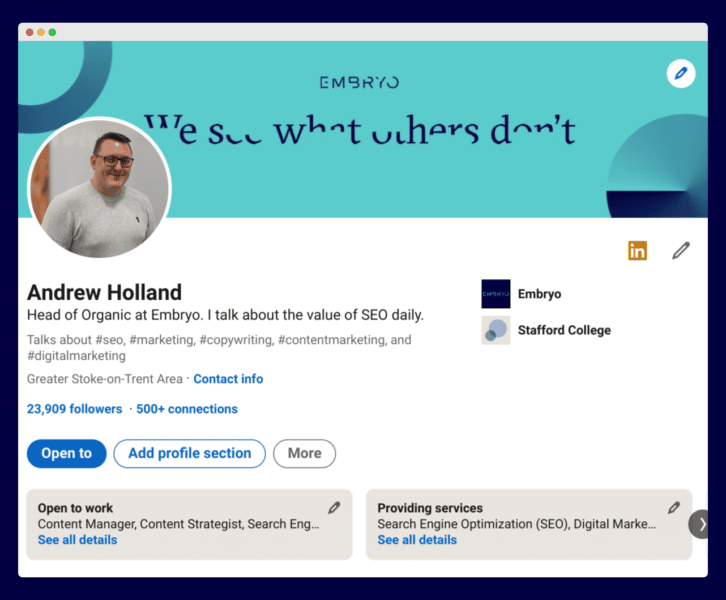
Today, I write daily on Linkedin and have grown a decent following.

Andrew Holland - LinkedIn profile

But that’s social content leveraging the platforms’ algorithms.

When I talk about regular content, I talk about blog posts with zero keyword research.

They’re written for a human reader, and if Google finds some keywords, great. But that’s accidental.

Regular content is a brave thing to create. It’s risky and a step into the unknown, and unless you have a promotion strategy, the likelihood is high that no one will ever read your post.

It might be your ideas, theories or passion.

In contrast, SEO content has a purpose – to rank.

The simple idea is that you’re writing this for search engines and humans.

You’re ranking the content so the content can be discovered via organic search.

Unless the content is written only with search engines in mind, you’ll struggle to have your content discovered. 

Does that make SEO content better? No.

As we’ll see shortly, an abundance of content sticks its fingers up at search engines and does pretty well.


Get the daily newsletter search marketers rely on.

Processing…Please wait.


Human leverage: The focus of content

Okay, so you have two types of content. We've seen that one leverages search engines.

But what does the regular kind of content leverage?

Humans.

In particular, human attention and human interaction.

Content for search engines tries to do this. Arguably, that's the fundamental skill of an SEO-focused content writer – trying to write content that is loved by both search engines and humans. And it's a real challenge.

On the other hand, content writers are not concerned with these things.

They share ideas, news, thoughts, opinions and information of use.

Unconstrained by the needs and wants of search engines, a certain freedom allows them to focus on one thing, to change the reader's emotional state.

That state might be that they feel that:

  • Their ideal future can be realized.
  • Their goals are closer.
  • They aren't failing as parents.
  • Life can be better.
  • Their business can succeed.

Be it entertaining or educating. Angering or mind-altering.

Great content makes emotional change happen – and it can be powerful.

But which type of writing is right for your business? 

'Content bothism': A secret weapon for marketing success

A good SEO once told me that one of his first SEO tasks is to kill low-traffic pages.

I get that. But low traffic doesn't mean low use.

Before you kill content, you need to be sure that the content isn't of use.

You might test this by promoting on social, even spending a bit of money to boost a post. That way you'll know if the content is useful to your customers.

The thing is, it doesn't have to be just SEO content or regular content. It should be SEO content and regular content.

"Content bothism" means using both types of content for your website. You can have the best of both worlds. And very often, that's how you can build a powerful online presence. 

So, what types of regular content can you create for people that don't leverage search?

3 content tactics you can use to leverage humans

Just because search is excellent, it doesn't mean we throw regular content under the bus. 

Once you know how to leverage human readership, you can create content that drives people to your site because it's brilliant. 

Here are three ways to leverage great content.

Variable reward content

Great blogs keep you coming back for more, as you never know what you'll read on them. This is known as variable reward content.

Social platforms such as TikTok and Instagram leverage variable reward content, but so do great websites. 

A great example of this is Tim Ferriss. His blog keeps you coming back for more because you never know what you've missed.

Tim Ferriss website

As a business, this kind of content is excellent because people search for you, not find you serendipitously through search.

The aim is simple – to hook the reader and get them coming back to you, time and time again. 

User-generated content 

Our next tactic is to get people to create the content for you.

Starter Story has done a super job of doing this.

Starter Story website

Through email interviews, their site has hundreds of great start-up stories.

And they haven't had to write them. This has provided their site with over 4,000 case studies.

Even if you manage to read them all, they keep adding more each week.

None of these are written for search engines, but the volume and the nature of the content are a magnet for readers. 

Content curation (with insight)

Content curation is nothing new. Websites have been using content curation for years, and Reddit is arguably the best on the web.

But when you add your unique insight, you tend to create a new version of the content.

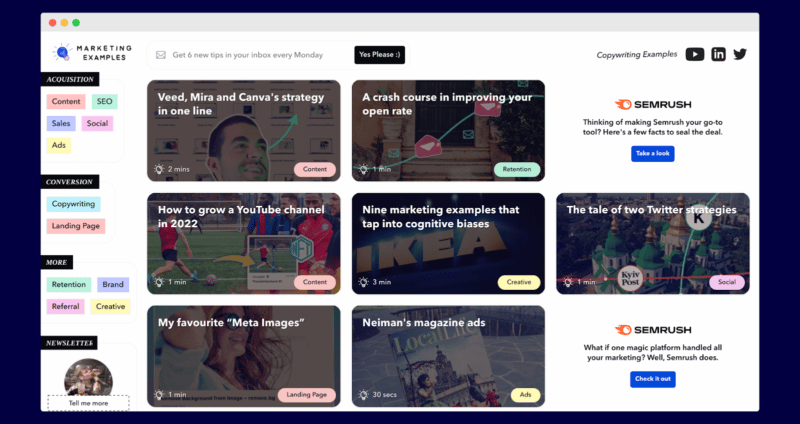
Marketing Examples is an excellent example of this. The best marketing examples are curated in one location, with unique views and images.

Marketing Examples website

But does SEO content have to be dull and robotic? 

Not a chance.

SEOs ruined the web – and only SEOs can fix it

We've all heard the stories Google is losing market share to TikTok.

We all hate reading an article that is thin and only ranked because of the power of the domain behind it.

Hopefully, recent algorithm updates will change this. But if we want SEO content to be better, SEOs and their content writers need to change this.

So, what do people want from good SEO content?

Good SEO content answers the search query and adds what wasn't there before.

It's the proper combination of content writing and SEO content writing. You answer the search query, and then you go beyond.

Seth Godin has some excellent tips for writing blogs that work well.

"Cross out every sentence that could have been written by someone else, every box check, every predictable reference. Now, insert yourself. Your truth and your version of what happens next."

While we don't want to cross out every sentence, excellent SEO content must add your unique views, experience and truths.

And if you're struggling to see examples of this in action, look no further than the Backlinko blog.

Brian Dean created a blog that didn't just leverage search. It leveraged both humans and search engines.

Dean creates content for search engines and still adds unique angles and experiences.

Brian Dean - Backlinko

It's why content UX, content design and the insertion of unique views and experiences matter more than ever.

But others also do this well.

BuzzSumo created an awesome content piece, 18 Examples Of Awesome B2B Content Marketing.

BuzzSumo - 18 Examples Of Awesome B2B Content Marketing

It's geared toward search and has had some success, but the BuzzSumo team leveraged their own data to produce a great and interesting article.

So, how could you start to make your SEO content stand out?

9 ways to create useful SEO content that humans love

Here are some ways to create helpful content for search engines and humans.

1. Add your own data

We saw how BuzzSumo added its data to create a unique content angle. 

What data do you have that you can use?

2. Add design

Brian Dean pioneered content design for SEO, but graphics can add a story to your content that you haven't thought of.

I get a lot of feedback for my simple graphics that help to explain topics.

LinkedIn post with graphic

3. Add facts

Facts make your content legit and reaffirm what you're trying to say. 

You can get these facts from sites such as Statista

4. Insert videos

Copywriter Ben Settle used to record himself talking on his phone while walking his dog. He'd then sell these insights as upsells for products.

I'm not saying you should do this, but create a short video, post it on YouTube, and embed it on your page. 

Perhaps you can explain something further or add a unique angle. Either way, you're adding things for humans within your SEO content.

5. Add unique H2s (that don't feature in the SERPs)

Modern web writing can be a tad regurgitated. People use tools such as Frase and Surfer to analyze the SERPs. 

To stand out, aim to add something new to the web, not just combine the best H2s and rewrite them.

What H2 can you add? What is the article missing?

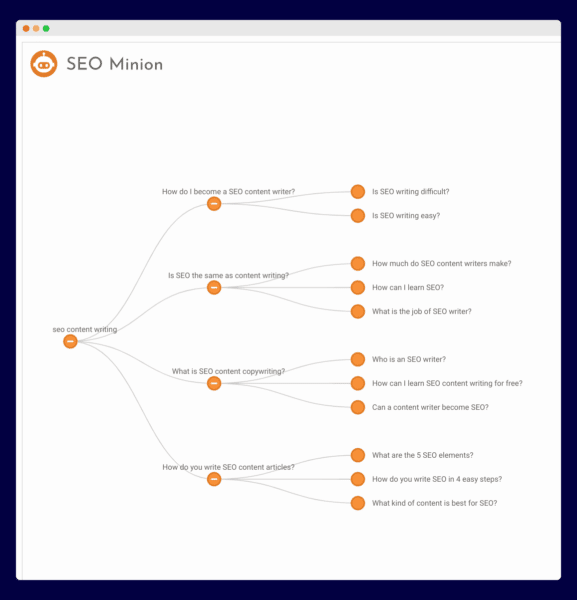
To find out what's missing, use the SEO Minion Chrome extension, and you can generate relevant People Also Ask questions for any keyword. Then add H2s not listed into your content.

SEO minion - Chrome extension

6. Add quick answers

Yes, this is a search issue. We know search loves quick answers.

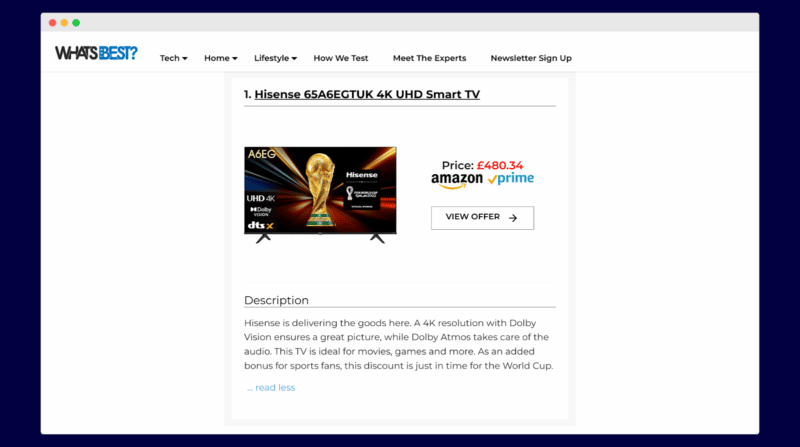
Today, I wanted to know some brief details about a TV I'm thinking of buying. I just wanted the information quickly. Many other buyers are like this, so try and get to the point.

Quick answers can be placed into boxes on your page to assist readers in finding key information.

What's Best article on TVs

The above page by What's Best allowed me to scroll through the best TVs and quickly gain information. 

Optimize for the fast reader.

7. Add specifications, details and numbers

With AI on the rise, you must add details because that's what AI can't add. Ensure you're adding relevant product and service data within the body of your content. 

This content by Quality Comix, which rates the 100 most valuable comics, provides key data that no AI program would have.

Quality Comix - 100 Best Comics

If you're using AI to aid in content writing, you need to add more elements that it couldn't have known or covered.

8. Commit to real answers

Experts give accurate answers to real problems. Quora was built on this.

Again, AI is vague while experts commit. If someone asks whether an air fryer is terrible for your health, answer the question firmly, not vaguely. 

Backing up your view with factual data helps, too.

9. Get quotes from business leaders

Businesses have business leaders. Get quotes from them, add them to the content and make your content pop. 

Make these quotes stand out on the page using design, and you'll find that it helps your content to read a lot better. 

What you should do next

SEO content is restricted to answering questions your customers have.

Content answers the questions that they don't know to ask.

Both are needed for a successful content strategy.

Remember, your content is probably not good enough for humans if you wouldn't pay to promote the content. So go and conduct a review of your content.

Is it good enough? Could it be better? If so, go to work and add some of the elements above.

Be brave. Be bold.

That's the future of both types of content. 

The post SEO content writing vs. content writing: The key difference appeared first on Search Engine Land.


via Search Engine Land https://ift.tt/zx5KqDm