Thursday, 3 August 2023

Trivago blames profit drop on opting out of new Google Ads product

Trivago’s decision to opt out of Google’s new property promotion ads was apparently a costly mistake.

Revenue was down 14% year-on-year to $137 million in the second quarter of 2023, following a decrease in website traffic, Trivago reported.

Meanwhile, revenue for Expedia, which did advertise with on the search engine’s new ad unit, reported a record second quarter with revenue up 6%.

A regretful data-led decision. Trivago did not to advertise with Google’s new ad product because it is part of Google hotel ads – which historically hasn’t performed well for the company, Skift reported. However, this soon became a decision the team would regret.

  • “We did not participate in this ad format prior to this rollout, and when this got more visibility [at the expense of] traditional advert placements, we lost traffic volumes,” said Trivago Chief Financial Officer Matthias Tillmann.

Why we care. When new ad products are launched, particularly by industry giants like Google, brands should make sure they are paying close attention and not be so quick to dismiss the possible potential. If financial risk is a concern, perhaps it may make more sense to trial a new product on a smaller scale rather than to disregard it all together. It’s also important that marketers ensure they are constantly monitoring the performance of their websites and campaigns. If you have noticed a drop in traffic, address it sooner rather than later to control financial losses.

Drop in ad spend. In its Q2 results, Trivago also announced that ad spend in the US had decreased by 10% to $32.9 million. The company spent 4% less on advertising in Europe, compared to the same period in 2022, as well. Commenting on the results, a company spokesperson said:

  • “Our reliance on search engines, particularly Google, which promote their own product and
    services that compete directly with our accommodation search and may negatively impact our
    business, financial performance and prospects.”

Get the daily newsletter search marketers rely on.

Processing…Please wait.


What has else Trivago said? Trivago addressed its Q2 results in a statement published on its website. A spokesperson said:

  • "We observed increased volatility in the results of our performance marketing campaigns. As we continued to be disciplined with Return on Advertising Spend (ROAS) targets, we experienced significant declines in performance marketing traffic volumes coupled with decreases in profit contribution."
  • "Despite these headwinds, we ramped up our brand marketing investments as planned. While these expenditures had a negative impact on our profitability in the second quarter of 2023, we believe they will have a long-term positive impact on the volume of direct traffic to our platform and our financial performance."

Deep dive. Read Trivago's Q2 2023 Earnings Release statement in full for more information.

The post Trivago blames profit drop on opting out of new Google Ads product appeared first on Search Engine Land.


via Search Engine Land https://ift.tt/PogIavu

Link building in 2023: 10 ways to win or fail

Link building is a consistent and proactive practice that requires time, effort and resources.

It remains a fundamental aspect of SEO, but success doesn’t come easily. 

As you fine-tune your SEO action plan for the rest of the year, consider ways to win – or fail – at link building. 

Fail: Ignoring personal connections

Start with who you know. You likely have personal connections in your industry who can help deliver valuable backlinks. 

So many marketers overlook their own network as a resource, focusing solely on cold outreach and missing out on opportunities for more natural, relevant links. 

Go through your LinkedIn connections, and ask. 

This is not simply a game of volume. In highly competitive niches, the quality and quantity of links matter. 

Getting a larger number of low-quality links is often easier, which will ultimately hurt your website’s SEO. 

Instead, strategically approach your backlinking efforts to ensure you gain high-quality and highly relevant backlinks from authoritative websites. 

When you go through the effort of building backlinks, one of the worst things you could do is select a domain that links back to completely unrelated websites. 

Building links that are relevant to your niche is critical. 

Getting links from irrelevant websites won’t help improve your search visibility or generate the readers and customers you seek. 

Fail: Ignoring local SEO 

Local SEO is a great opportunity to increase your backlinks, but many companies miss this step. 

Especially for businesses with a local audience, geo-targeted link building will help you increase your website’s local search visibility and be more relevant to your target audience. 

Work to obtain links from business listing websites, local blogs and local directories. 

Fail: Sticking to outdated tactics

It was never right, but we all know it happened. Old school and outdated tactics to get backlinks, such as spammy directories and mass blog commenting will only hurt your website’s SEO.

Google still will take manual action on sites that engage in these practices, so it’s essential to stay up-to-date with the latest link building strategies and ensure your efforts align with Google’s guidelines.

Dig deeper: Why most brands fail at link building: Top 5 mistakes


Get the daily newsletter search marketers rely on.

Processing…Please wait.


Evaluate your competitor’s ranking performance and backlink profile. This can help you understand your gaps and opportunities. 

What lists are they on? What interviews and guest posts have they done?  

If your competitors are appearing on specific domains, then there is an opportunity for you to be a fast follower. 

Use tools such as Ahrefs or Moz, and identify potential targets for your own link building efforts.

Win: Capitalizing on unlinked mentions

You’ll often find that your website or brand was mentioned on a site, but no link was associated with it. 

In these situations, reach out to the site operator and politely request they add a link to your site. 

Brand monitoring tools like Talkwalker, Critical Mention or BuzzSumo can help you find unlinked mentions, providing opportunities for easy link building.

Win: Contributing to crowdsourced posts

Participate in crowdsourced posts by providing expertise to journalists or bloggers seeking input from industry professionals. 

HARO is a great place to identify opportunities to contribute to content. This can lead to valuable backlinks from authoritative sources and increased visibility for your brand.

Win: Creating valuable data-driven content

Everyone loves visuals. Look for opportunities to create content from your valuable data, including infographics, research results, case studies and surveys. 

Citing statistics and percentages is also important, so focus on creating content that showcases your expertise and provides rare, insightful data. 

With the increasing use of Canva, it’s much easier to create compelling graphics for your website. 

Win: Getting help 

As you read this list of best practices, you’re likely asking, “How much time will this take?” 

Link building is time-consuming, but reputable consultants and agencies can do the tough parts for you, helping you increase your backlinks effectively and efficiently. 

Don't be scared to ask for help. 

Avoid common mistakes, embrace winning strategies

Focus on creating high-quality, link-worthy content and pursuing natural, relevant backlinks from authoritative sites. 

Understand that link building is a long-term effort requiring consistent monitoring and effort.

Adopting these practices will improve your website's visibility and boost its SEO performance in the long run.

The post Link building in 2023: 10 ways to win or fail appeared first on Search Engine Land.


via Search Engine Land https://ift.tt/cBLmy89

Margin-based tracking: 3 advanced strategies for Google Shopping profitability

Are your Google Shopping campaigns profitable? 

Tracking your PPC performance will help you make better business decisions. 

You can unlock data beyond basic revenue metrics by implementing margin-based structures and advanced tracking methods. 

This article discusses three strategies to approach profitability-based tracking and campaign structuring methods.

1. Profitability-based account structures

The easiest and fastest way to start is with margin- or inventory-based structures. 

They revolve around three key concepts:

  • Product profitability.
  • Inventory status.
  • Campaign segmentation. 

These elements work together to drive profitability in Google Ads.

Product profitability

When you know the profitability of individual products, you can prioritize efforts and allocate budgets more effectively. 

Start by analyzing the cost of goods sold (COGS) and factoring in other costs associated with production, packaging and shipping. 

Transferring the COGS or product margin into a custom label enables you to segment Performance Max campaigns in margin-based clusters.

Inventory status

The inventory should be clustered in priority or inventory status on a scale like low, medium or high to make it useful.

Campaign segmentation

Segmenting your Performance Max campaigns based on product profitability and inventory status is the final and crucial step in margin-based structures. 

You can now:

  • Create a product scoring out of the profitability and inventory custom label.
  • Or use them separately and build campaigns like “high margin – high inventory status” to push certain products. 

This segmentation lets you apply different bidding strategies and budgets to each group and allocate resources where they will generate the highest returns.

Google frames this approach as “Shopping for Business Objectives.” 

Theoretically, this should lead to profitable campaigns because the bidding strategy can focus on one goal, which should work for most products in that cluster. 

While it works great for advertisers with few margin clusters and simple product structures, it has a few flaws. 

It’s impossible to visualize which products were bought, and hard to see how the gross profit of a campaign looks because you just throw similar margins into one basket. 

This strategy is a decent solution for starters, but should be improved to get more leverage.


Get the daily newsletter search marketers rely on.

Processing…Please wait.


2. Tracking cost of goods sold (COGS) and reporting conversion with cart data

Cost of goods sold (COGS) tracking and conversions with cart data reporting are among the most overlooked built-in features of Google Ads. 

COGS is an optional value that can be passed to the Merchant Center in the data feed for Google Shopping. 

The attribute [cost_of_goods_sold] represents the cost price at the product level and must be specified as a monetary value (i.e., not as a percentage). 

Since purchase prices can change more quickly depending on the industry, working with an approximate guideline at the beginning is advisable.

Most companies have their COGS stored in their enterprise resource planning (ERP) software, while some might also store it in their shop backend. 

It’s ideal to dynamically export those values into your feed management application of choice. However, you can start out with a static export if automation is out of the question. 

For example, you could create a sub-feed with a Google Sheet. 

Just fill in the item id [id] and cost of goods sold [cost_of_goods_sold] in the first two columns and then import it as a supplemental feed into Merchant Center.

Implementing COGS in the product data and cart data reporting in the GTAG also lets you use additional metrics like gross profit, COGS, product gross profit, etc. They are a great addition to the basic revenue pixel that most advertisers optimize on.

From a technical perspective, it might look a bit complex to implement. But all variables needed are within the analytics dataLayer and can easily be used when using a Google Tag Manager (GTM) setup.

3. Custom margin tracking

The most advanced and complex solution is to use custom margin tracking and set up a dedicated pixel. 

Some tools integrate with shop systems, but setting up your own tracking offers independence and customization options. 

But if you’re looking for a quick and easy solution to implement, profitability tracking tools might be enough to do the job.

Many shop systems enable setting the COGS or item cost for internal reporting reasons. You can transmit the value into the data layer, which you can later use for conversion tracking.

For instance, Shopify allows you to set metafields, which you can use to set the COGS on a product level. 

Below, you’ll find an example metafield used to capture the product costs.

Product metafield in Shopify

Luckily, Shopify allows us to read the metafield value on the storefront, which we can use to transmit it into the dataLayer. 

Depending on the dataLayer, the specific code must be individualized. 

Here’s sample data that we could use with a dataLayer.push command

<script>
window.dataLayer = window.dataLayer || [];
window.dataLayer.push({
 'COGS': ''
 });
</script>

We can make it available for further use GTM.

We can now calculate our profit using a custom JavaScript snippet or any other way depending on the technical circumstances.

var costOfGoodsSold = ; 
var revenue = ; 
// Calculate profit 
var profit = revenue - costOfGoodsSold;
console.log(profit);

Using the profit variable as a revenue variable in the GTAG lets us purely track profit on our marketing activities. 

Tip: This setup opens the risk of competitors spying on our dataLayer. 

To address this, you can build in a factor of the gross profit. 

This cloaks cost data from competitors and makes it easier for your account managers to work with bidding strategies.

So instead of reporting back a gross profit of $20 from a $100 order, you could factor it by 5 and report back a $100 order. 

If you know about the factor of 5, you can now easily calculate the true gross profit by dividing numbers by 5 or whatever factor you’d like to use.

Profit-driven strategies for better advertising ROI

Profitability-based tracking in Google Ads offers advanced insights into campaign and product performance. 

Whether it's structuring campaigns with inventory and margin data, implementing COGS tracking, or using custom margin tracking pixels, there's a solution for every situation. 

Standard GTAG pixel and revenue tracking are not enough for data-driven decisions. 

Advanced reporting and analysis enable you to:

  • Identify high-profit opportunities.
  • Optimize bidding and budgeting strategies.
  • Enhance overall campaign profitability. 

Embrace margin-based tracking to push your ecommerce business forward.

The post Margin-based tracking: 3 advanced strategies for Google Shopping profitability appeared first on Search Engine Land.


via Search Engine Land https://ift.tt/4rDVIJZ

Wednesday, 2 August 2023

Google Search Generative Experience adds videos to AI-generated answers

Google’s new Search Generative Experience now can not just show images in the AI-generated answer but also can show playable videos. “Over the next week, you’ll begin to see videos within some overviews where it’s helpful to see something in motion,” Google wrote.

What it looks like. Google sent us a screenshot for a query on [how to get stains out of marble type] that shows a video embedded directly in the AI-generated answer. You can click on the image to enlarge it:

More improvements. Google also confirmed rolling out links in the AI-generated answers, something we covered yesterday. “To help you better understand how recent the information is from these web pages, we recently added publish dates to each link,” Google wrote. Google added will continue “to experiment with new, easier ways for people to find web pages that support information in AI overviews.”

Google also said it will continue to make speed improvements to these AI-generated answers, after significantly improving the speed of the answers in early June. Google said, ” we’re continuing to experiment with new, easier ways for people to find web pages that support information in AI overviews.”

Why we care. If you create videos, your videos, in addition to images, can now show up in these AI-generated answer sections within the Search Generative Experience. Plus, as we said yesterday, having links directly in these answers can help generate more traffic to your site. Finally, faster answers means more searchers will consume these answers, instead of scrolling past them if they do not load fast enough.

The post Google Search Generative Experience adds videos to AI-generated answers appeared first on Search Engine Land.


via Search Engine Land https://ift.tt/SvtPNFL

Google Chrome adds search suggestions, trending searches on mobile

Google is adding four new search-related features to the mobile version of Chrome. The new features will give you more search suggestions and tell you what’s trending in Google Search, the company announced.

Search suggestions related to this page. The new mobile Chrome can show a “Related to this page” section for “eligible” sites after you click on the Chrome address bar. This section will show you relevant search suggestions based on that specific webpage.

  • For example, you can see local restaurants or tourist attractions specific to Japan:

Trending searches. You can see trending Google searches directly in the Chrome address bar in Chrome for Android (this feature is coming to iOS Chrome later this year).

  • How to see this: Open a new tab, tap the address bar and scroll down to see what’s trending. You can also click on a trending search to see search results for that topic and learn more about it.

Related Search for Touch to Search. Google’s upgraded Touch to Search for Android feature will now show related searches when you tap on any word on a webpage.

  • How it works: Highlight a word or phrase and Google will show you a carousel of related searches will pop up at the footer.

More search suggestions. Google added four additional search suggestions in the Chrome address bar. That means Chrome will now show 10 search suggestions, rather than six.

This feature already had been live for Android users, but it is new and rolling out for iOS Chrome users.

  • The “most relevant suggestions will appear first, and you can access more options by scrolling,” Google said.

Why we care. You can leverage these search tools to find related topics to a specific site or phrase. Then take these ideas back to your content team to create more useful and helpful content for either your existing content pages or for new content pages. Also, these features are pretty helpful for many searchers.

The post Google Chrome adds search suggestions, trending searches on mobile appeared first on Search Engine Land.


via Search Engine Land https://ift.tt/MjyfHJ5

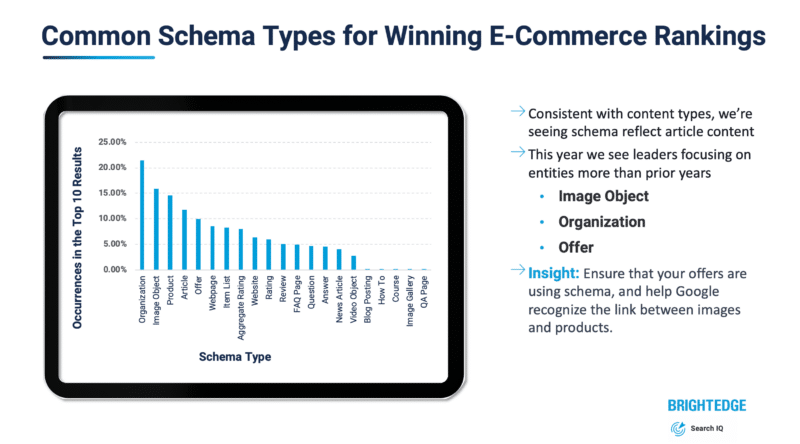
Schema usage up 4x among top ranking ecommerce sites

With SEO planning for the holiday season already underway, schema usage seems to be a top priority for ecommerce brands that own the top-ranking keyword positions.

Compared to 2022, schema adoption has increased 4x, according to data from SEO enterprise platform BrightEdge.

Why we care. Ecommerce is often a bellwether, where SEO strategies, tactics and techniques change before other sectors. So it’s always interesting to watch and see what’s trending among the leading ecommerce brands and what they prioritize in their holiday strategies.

Trending schema types. This year’s big focus is on images and products. Three types of schema are trending among ecommerce brands:

  • Image object
  • Organization
  • Offer

Last year, brands were more focused on articles and items.

Why the shift. There are at least two Google-related factors at play here:

  • Helpful content update (HCU). We know a helpful content update is coming, but not when or how big of an impact it will have
  • Search Generative Experience (SGE). We know SGE is Google’s vision for the future of search, but we don’t know whether SGE will be fully deployed to all users before, during or after the holiday season.
  • “With SGE and HCU, providing proof of who you are and showing credibility through third-party confirmation is vital. Schema is becoming a necessity, not an option as shown by brands increasing usage. To stay ahead and succeed in AI-driven search, it is crucial for organizations to incorporate schema markup and focus on structuring the data on their websites,” said BrightEdge CEO Jim Yu.

Brands starting early in 2023. JCPenney is one brand that is starting earlier than ever.

  • “We just kicked off our back-to-school season and all the optimization that goes with that, but we’re also scoping out what we want to do for the holidays by researching our competition and content gaps to put our site and pages in the best positions possible. Starting earlier and planning with our other teams puts us in a really good position to be ready to pivot and adjust as needed,” said Timothy Huneycutt, JCPenney’s SEO manager, digital operations.

About the data. The insights from BrightEdge are based on tracking 6,000 ecommerce keywords in 10 categories, which the company has been doing for the past four years.

The post Schema usage up 4x among top ranking ecommerce sites appeared first on Search Engine Land.


via Search Engine Land https://ift.tt/l3ULg9z

How to create a link building strategy

A link building strategy involves understanding:

  • Your content assets.
  • The people who consume and create your content.
  • How your content is shared.

This information helps create a guiding policy that leads to coherent actions, adding value for content creators and encouraging them to share your content.

The ultimate goal is to build the reputation of your page, website and content creators.

This article examines what makes a “good strategy” and a simple method to map a situation analysis to a strategic framework.  

Learn a method for applying helpful strategy and planning insights to your situation and turn it into actionable steps for your next link building campaign.

What is a strategy?

Before we jump into link building strategy, let’s take a quick step back to define what exactly we mean by “strategy.”

A strategy is how one organizes all available resources to navigate an environment to accomplish a goal or objective.

In “Good Strategy, Bad Strategy,” author Richard Rumelt argues that an effective strategy has three fundamental ingredients:

  • Diagnosis: Understanding the nature of the challenge.
  • Guiding policy: Overall approach selected to handle all obstacles to accomplish the goal.
  • Coherent actions: Coordinated steps to support the guiding policy.

Imagine snowboarding (or skiing) down a mountain. 

The line you pick – to bypass obstacles or face them – is a strategy for reaching the mountain’s base fast or for other goals.

Yet, it’s common to consider a “tactic” a “strategy.” 

For instance, “guest posting” is not a link building strategy. I would define guest posting as a tactic or technique to include in a strategy.

The guiding policy can either explore unique paths or follow behind the competitor and make something better, represented well by the “blue ocean” concept.

  • Blue ocean strategy: Spur demand in a fresh, unexplored market segment.
  • Red ocean strategy: Set your business apart from theme competitors in an already populated market.

While building a guiding policy, understand these areas to provide insights to evaluate for adjustment, enhancement, or complete reworking.

  • Budget: How much is being spent on the product? What does it cost the user?
  • Value creation: What problem does the software or product solve? What is that worth?
  • Internal workflows and resources: Create a competitive advantage by being more efficient.
  • Knowledge enhancement and growth: Are you smarter than the competition in a particular area?
  • Ethical considerations: Are there ethical factors limiting what can be built?

Taking a cue from Rand Fishkin’s advice on creating a great marketing strategy, look into the following:

  • Content creators: Individuals, businesses or organizations that create and publish content with varying goals.
  • Content consumers: Individuals or entities that consume the content, including other content creators and search engine bots.
  • Platforms: Websites, social media networks, forums, and other online spaces where content is published and shared.
  • Content: Various forms of content (e.g., blog posts, videos, infographics) are valued based on quality, relevance, uniqueness, and creator authority. This is owned assets or independent assets.
  • Competition: High level of competition due to the abundance of content being created and shared daily.
  • Trends: Influences such as content format trends, platform preferences, consumer behavior, and SEO practices.
  • Link building: Secure a link so users can click and navigate.

To illustrate, let’s break down the Skyscraper technique and apply it to an HR software’s link building strategy.

Diagnosis

Skyscraper technique

  • Diagnose the current state of owned content assets, their consumers, and the creators that share them.
  • Identify existing content that has already generated a significant number of links. The creators who have linked to this content are potential consumers of your own content.
  • Understand the online asset-sharing marketplace, which is highly competitive and saturated with content

Specific application

  • For HR management software, the top content ranking in Google does not discuss generative AI for HR management. Still, it’s a highly significant technology impacting the HR manager’s role.
  • There’s other online content about HR and generative AI, but all that information can be aggregated into one page to create more value.
  • The top content also doesn’t provide examples, and it is difficult to scan to find helpful content quickly.

Guiding policy

Skyscraper technique

  • Navigate the online asset-sharing marketplace by creating superior content that provides value to content creators.
  • Create content that is superior to existing content. This superior content is expected to attract content creators who are looking for valuable content to share with their own audience.

Specific application

  • Blue ocean
    • Perform a study of HR professionals to uncover their unique processes.
    • Build 3 AI tools for each time-consuming step, then have them tested.
    • Identify 5+ MVP (minimum viable product) AI tools that can drastically improve the employee review process to improve quality and reduce time.
  • Red ocean
    • Create a guide to top HR recruiting software using AI.
    • Leverage the company’s unique application of ChatGPT in the HR recruitment process to create engaging content for HR and technology podcasts.

Coherent actions

Find link-worthy content

  • Skyscraper technique: Identify existing content that has already generated many links. This serves as the benchmark for creating your own content.
  • Specific application: Top-ranking content that generates links and doesn’t cover the topic thoroughly, excluding generative AI.

Make something even better

  • Skyscraper technique: Create content that is superior to the existing content by making a more thorough, up-to-date, and better-designed piece or creating something completely unique.
  • Specific application: Create a data-driven article for “technology that will kill HR jobs in 5 years” from the study.

Reach out to the right people

  • Skyscraper technique: Identify and reach out to people who have already linked to similar content via email to get them to link to your superior content.
  • Specific application: Reach out to the sites that link to the top-ranking content and HR technology blogs to discuss the future of AI in HR technology.

Get the daily newsletter search marketers rely on.

Processing…Please wait.


You can also craft a unique approach with the fundamental elements of a good strategy.

For instance, I created a new technique and applied it to a hypothetical scenario for HR software.

"The Collective" is a win-win strategy. Contributors get visibility and recognition, while you get high-quality content and potential backlinks. 

Plus, the collaborative nature of the content makes it more likely to be shared and linked to, as it represents the collective knowledge and insights of the community.

Diagnosis

Collective technique

  • Identify a topic relevant to your industry (i.e., a trending topic, a common challenge, or an area of interest) and has a large community of interested individuals or businesses.

Specific application

  • HR software focused on B2B audiences that reduce recruiting management time with AI automation.
  • A lot of content is being produced around generative AI. A small number of people on Reddit are discussing the negative impact AI might have on HR manager roles and taking jobs.

Guiding policy

Collective technique

  • Create a collaborative piece of content that involves contributions from various community members. This could be expert insights, case studies, personal experiences, or other valuable contributions.

Specific application

  • Blue ocean
    • Connect internal experts (SMEs) with the Reddit community to ask what technical questions have not been asked around the topic but are essential.
    • Create a list of top-engaged experts, then have internal SMEs create an article explaining the topic of discussion, sharing the Reddit comments.
  • Red ocean:
    • Create a listicle roundup from expert community members' comments.
    • Ask them to expound their comments through an article or a more in-depth contribution for a quote or valuable insight.

Coherent actions

Identify contributors

  • Collective technique
    • Select a trending topic and reach out to potential contributors within the community (i.e., industry experts, influencers or other key individuals who have valuable insights to share).
    • Explain your project and invite them to contribute.
  • Specific application
    • A certain HR influencer on YouTube has HR professional followers discussing generative AI's impact on their jobs. The influencer and followers examine the risks of losing their jobs from AI, with no examples of how it creates risk.

Create collaborative content

  • Collective technique
    • Compile the contributions into a comprehensive piece of content (i.e., a blog post, ebook or video).
    • Make sure to give proper credit to all contributors.
  • Specific application
    • Create content from internal SMEs community conversations in blog articles, screenshots from conversations, and listicles.
    • Compile unique insights that can be discussed.

Promote content

  • Collective technique
    • Encourage the contributors to share the content with their audience and the influencers they engage with.
  • Specific application
    • Share content in the original threads and directly with the community members, explaining that the insight was shared in the blog posts.

Engage with the community

  • Collective technique
    • Continue to engage with the community after the content has been published.
    • Respond to comments, participate in discussions and show appreciation for shares and links. Doing so helps build relationships that can lead to more link opportunities in the future.
  • Specific application
    • Start a discussion around new insights or critical points from the article and community members.

After the strategy framework is designed, apply it to your situation.

This method of mapping strategy can be applied to any link building technique.

My Search Engine Land article on ways to build links for any site touches on some of the most popular techniques, including:

Guest posting for subject matter experts (SMEs)

  • An expert from your company contributes a unique piece of content to another website, including a link to your site.

Broken link building

  • Find broken links on other websites, suggest your own relevant content as a replacement, and ask the site owner to link to your content instead.

Podcast guest

  • A representative from your company appears as a guest on a podcast, and a link to your website is included in the show notes or podcast description.

Unlinked brand mentions

  • Find instances where your brand is mentioned online but not linked to, and you reach out to the site owner to request a link.

Resource page link building

  • Create high-quality, valuable content relevant to a specific topic, and then reach out to websites with resource pages on that topic to include a link to your content.

Linkable content (no sharing)

  • Create high-quality content on your own website that is so valuable and unique that other websites naturally want to link to it.

Linkable content (sharing)

  • Create high-quality content and actively promote it to other websites, influencers, or on social media to encourage others to link to it.

Listicle roundups

  • Create a listicle (a list-based article) featuring top resources, influencers, or trends in your industry, encouraging those featured to link back to it.

Competitor link building

  • Analyze where your competitors are getting their backlinks from, and then reach out to those websites to try and get them to link to your content.

Strategy development and planning processes

A strategy for link building can be broken down into a simple process of:

  • Selecting the technique.
  • Mapping to the strategy framework.
  • Mapping the framework to specific analysis, policy, and steps.

Step zero is to identify SEO goals and objectives, then use that direction as a guiding light for the policy to navigate toward.

Step 1: Analyze and diagnose issues

  • Prep work:
    • Identify your specific goals, objectives, and resources.
    • Analyze the content ecosystem in the targeted keyword cluster or niche.
  • Broad technique selection: Select the overarching strategy or technique that aligns with your identified goals and constraints.
  • Specific application: Use your understanding of the ecosystem to tailor the broad technique to your unique situation.

Step 2: Map technique to table of elements

  • Select ocean: Select the type of strategy to either create something completely new and disruptive or something better than the competition.
  • Create options: Create guiding policy options for each ocean.
  • Select the ocean based on the analysis and likelihood of success against risk tolerances.

Step 3: Develop steps

  • Identify people, processes and technology: Determine what you need to support your strategy.
  • Plan development: Develop the general steps incorporating these elements and detail how you'll implement your strategy.
  • Documentation: Document the strategy in an SOP or process map.

Take action

Now you have the knowledge and tools to craft and implement effective link building strategies. 

By understanding the distinction between tactics and strategies, and following the step-by-step guide, you can:

  • Diagnose your current situation.
  • Develop a guiding policy.
  • Execute coherent actions. 

Whether you're navigating a saturated market or exploring uncharted territories, these insights can help you create value for your customers, stand out from the competition and achieve your marketing objectives.

It's your turn to apply these insights to your unique context. Happy strategizing!

The post How to create a link building strategy appeared first on Search Engine Land.


via Search Engine Land https://ift.tt/guVpvkB