Monday, 8 January 2024

Advanced AI prompt engineering strategies for SEO

My team and I have written over 100 production-ready AI prompts. Our criteria are strict: it must prove reliable across various applications and consistently deliver the correct outputs.

This is no easy endeavor.

Sometimes, a prompt can work in nine cases but fail in the 10th.

As a result, creating these prompts involved significant research and lots of trial and error. 

Below are some tried-and-true prompt engineering strategies we’ve uncovered to help you build your own prompts. I’ll also dig into the reasoning behind each approach so you can use them to solve your specific challenges. 

Getting the settings right before you write your first prompt

Navigating the world of large language models (LLMs) can be a bit like being an orchestra conductor. The prompts you write – or the input sequences – are like the sheet music guiding the performance. But there’s more to it.

As conductors, you also have some knobs to turn and sliders to adjust, specifically settings like Temperature and Top P. They’re powerful parameters that can dramatically change the output of your AI ensemble. 

Think of them as your way to dial up the creativity or rein it in, all happening at a critical stage – the softmax layer. 

At this layer, your choices come to life, shaping which words the AI picks and how it strings them together.

Here’s how these settings can transform the AI’s output and why getting a handle on them is a game-changer for anyone looking to master the art of AI-driven content creation.
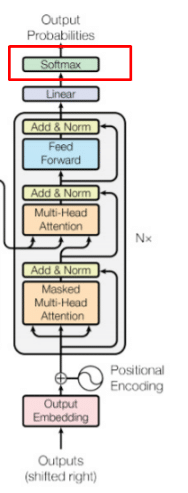
Output probabilities

To ensure you’re well-equipped with the essential information to grasp the softmax layer, let’s take a quick journey through the stages of a transformer, starting from our initial input prompt and culminating in the output at the softmax layer.

Imagine we have the following prompt that we pass into GPT: “The most important SEO factor is…”

  • Step 1: Tokenization
    • The model converts each word into a numerical token. For example, “The” might be token 1, “most” token 2098, “important” token 4322, “SEO” token 4, “factor” token 697, and “is” token 6.
    •  Remember, LLM’s (large language models) deal with number representations of words and not words themselves. 
  • Step 2: Word embeddings (a.k.a., vectors)
    • Each token is transformed into a word embedding. These embeddings are multi-dimensional vectors that encapsulate the meaning of each word and its linguistic relationships.
    • Vectors sound more complicated than they are, but imagine we could represent a really simple word with three dimensions, such as [1, 9, 8]. Each number represents a relationship or feature. In GPT models, there are often 5,000 or more numbers representing each word. 
  • Step 3: Attention mechanism
    • Using the embeddings of each word, a lot of math is done to compare the words to each other and understand their relationships to each other. The model employs attentional weights to evaluate the context and relationships between words. In our sentence, it understands the contextual importance of words like “important” and “SEO,” and how they relate to the concept of an “SEO factor.”
  • Step 4: Generation of potential next words
    • Considering the full context of the input (“The most important SEO factor is…”), the model generates a list of contextually appropriate potential next words. These might include words like “content,” “backlinks,” “user experience,” reflecting common SEO factors. There are often huge lists of words, but they have varying degrees of likelihood that they would follow the previous word. 
  • Step 5: Softmax stage
    • Here, we can adjust the output by changing the settings.
    • The softmax function is then applied to these potential next words to calculate their probabilities. For instance, it might assign a 40% probability to “content,” 30% to “backlinks,” and 20% to “user experience.”
    • This probability distribution is based on the model’s training and understanding of common SEO factors following the given prompt.
  • Step 6: Selection of the next word
    • The model then selects the next word based on these probabilities, making sure that the choice is relevant and contextually appropriate. For example, if “content” has the highest probability, it might be chosen as the continuation of the sentence.

Ultimately, the model outputs “The most important SEO factor is content.” 

This way, the entire process – from tokenization through the softmax stage – ensures that the model’s response is coherent and contextually relevant to the input prompt.

With this foundation in place – understanding how AI generates a vast array of potential words, each assigned with specific probabilities – we can now pivot to a crucial aspect: manipulating these hidden lists by adjusting the dials, Temperature and Top P. 

First, imagine the LLM has generated the following probabilities for the next word in the sentence “The most important SEO factor is…”:
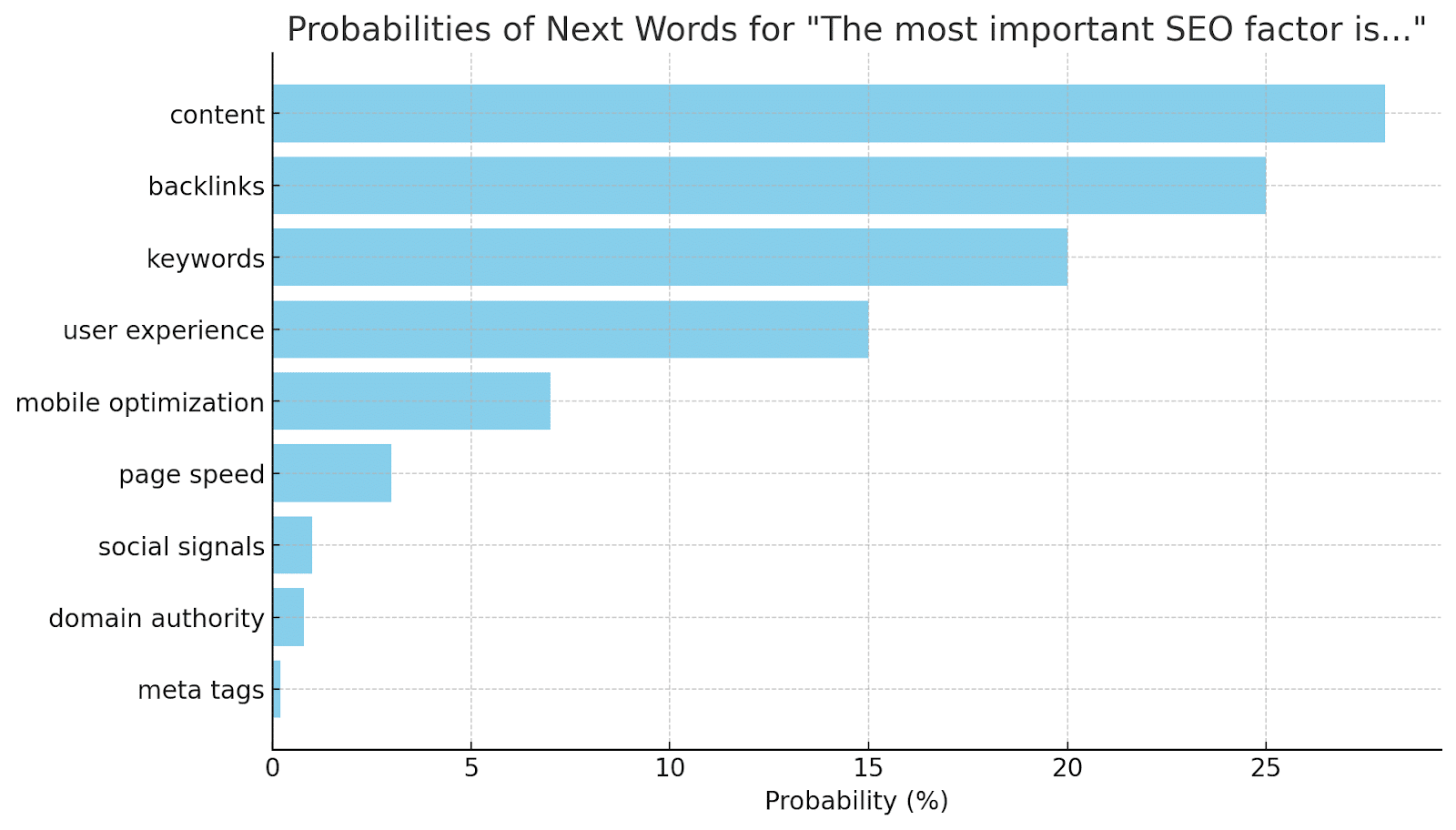
Probabilities of next words

Adjustable settings: Temperature and Top P

Adjustable settings: Temperature and Top P

Impact of adjusting Temperature

The best way to understand these is to see how the selection of possible words might be affected by adjusting these settings from one extreme (1) to (0). 

Let’s take our sentence from above and review what would happen as we adjust these settings behind the scenes. 

  • High Temperature (e.g., 0.9):
    • This setting creates a more even distribution of probabilities, making less probable words more likely to be chosen. The adjusted probabilities might look like this:
      • “content” – 20%
      • “backlinks” – 18%
      • “keywords” – 16%
      • “user experience” – 14%
      • “mobile optimization” – 12%
      • “page speed” – 10%
      • “social signals” – 8%
      • “domain authority” – 6%
      • “meta tags” – 6%
    • The output becomes more varied and creative with this setting.

Note: With a broader selection of potential words, there’s an increased chance that the AI might veer off course.

Picture this: if the AI selects “meta tags” from its vast pool of options, it could potentially spin an entire article around why “meta tags” are the most important SEO factor. While this stance isn’t commonly accepted among SEO experts, the article might appear convincing to an outsider. 

This illustrates a key risk: with too wide a selection, the AI could create content that, while unique, might not align with established expertise, leading to outputs that are more creative but potentially less accurate or relevant to the field.

This highlights the delicate balance needed in managing the AI’s word selection process to ensure the content remains both innovative and authoritative.

  • Low Temperature (e.g., 0.3):
    • Here, the model favors the most probable words, leading to a more conservative output. The probabilities might adjust to:
      • “content” – 40%
      • “backlinks” – 35%
      • “keywords” – 20%
      • “user experience” – 4%
      • Others – 1% combined
    • This results in predictable and focused outputs.

Impact of adjusting Top P

  • High Top P (e.g., 0.9):
    • The model considers a wider range of words, up to a cumulative probability of 90%. It might include words up to “page speed” but exclude the less probable ones.
    • This maintains output diversity while excluding extremely unlikely options.
  • Low Top P (e.g., 0.5):
    • The model focuses on the top words until their combined probability reaches 50%, possibly considering only “content,” “backlinks,” and “keywords.”
    • This creates a more focused and less varied output.

Application in SEO contexts

So let’s discuss some of the applications of these settings: 

  • For diverse and creative content: A higher Temperature can be set to explore unconventional SEO factors.
  • Mainstream SEO strategies: Lower Temperature and Top P are suitable for focusing on established factors like “content” and “backlinks.”
  • Balanced approach: Moderate settings offer a mix of common and a few unconventional factors, ideal for general SEO articles.

By understanding and adjusting these settings, SEOs can tailor the LLM’s output to align with various content objectives, from detailed technical discussions to broader, creative brainstorming in SEO strategy development.

Broader recommendations 

  • For technical writing: Consider a lower Temperature to maintain technical accuracy, but be mindful that this might reduce the uniqueness of the content.
  • For keyword research: High Temperature and High Top P if you want to find more and unique keywords. 
  • For creative content: A Temperature setting around 0.88 is often optimal, offering a good mix of uniqueness and coherence. Adjust Top P according to the desired level of creativity and randomness.
  • For computer programming: Where you want more reliable outputs and usually go with the most popular way of doing something, lower Temperature and Top P parameters make sense. 

Get the daily newsletter search marketers rely on.


Prompt engineering strategies 

Now that we’ve covered the foundational settings, let’s dive into the second lever we have control over – the prompts. 

Prompt engineering is crucial in harnessing the full potential of LLMs. Mastering it means we can pack more instructions into a model, gaining finer control over the final output. 

If you’re anything like me, you’ve been frustrated when an AI model just ignores one of your instructions. Hopefully, by understanding a few core ideas, you can reduce this occurrence. 

1. The persona and audience pattern: Maximizing instructional efficiency

In AI, much like the human brain, certain words carry a network of associations. Think of the Eiffel Tower – it’s not just a structure; it brings to mind Paris, France, romance, baguettes, etc. Similarly, in AI language models, specific words or phrases can evoke a broad spectrum of related concepts, allowing us to communicate complex ideas in fewer lines. 

Implementing the persona pattern

The persona pattern is an ingenious prompt engineering strategy where you assign a “persona” to the AI at the beginning of your prompt. For example, saying, “You are a legal SEO writing expert for consumer readers,” packs a multitude of instructions into one sentence.

Notice at the end of this sentence, I apply what is known as the audience pattern, “for consumer readers.” 

Breaking down the persona pattern

Instead of writing out each of these sentences below and using up a large portion of the instruction space, the persona pattern allows us to convey many sentences of instructions in a single sentence. 

For example (note this is theoretical), the instruction above may imply the following. 

  • “Legal SEO writing expert” suggests a multitude of characteristics:
    • Precision and accuracy, as expected in legal writing.
    • An understanding of SEO principles – keyword optimization, readability, and structuring for search engine algorithms.
    • An expert or systematic approach to content creation.
  • “For consumer readers” implies:
    • The content should be accessible and engaging for the general public.
    • It should avoid heavy legal jargon and instead use layman’s terms.

The persona pattern is remarkably efficient, often capturing the essence of multiple sentences into just one.

Getting the persona right is a game-changer. It streamlines your instruction process and provides valuable space for more detailed and specific prompts.

This approach is a smart way to maximize the impact of your prompts while navigating the character limitations inherent in AI models.

2. Zero shot, one shot, and many shot inference methods

Providing examples as part of your prompt engineering is a highly effective technique, especially when seeking outputs in a particular format.

You’re essentially guiding the model by including specific examples, allowing it to recognize and replicate key patterns and characteristics from these examples in its output. 

This method ensures that the AI’s responses align closely with your desired format and style, making it an indispensable tool for achieving more targeted and relevant results.

The technique takes on three names. 

  • Zero shot inference learning: The AI model is given no examples of the desired output. 
  • One shot inference learning: Involves providing the AI model with a single example of the desired output. 
  • Many shot inference learning: Provides the AI model with multiple examples of the desired output. 

Zero shot inference

  • The AI model is prompted to create a title tag without any example. The prompt directly states the task.
  • Example prompt: “Create an SEO-optimized title tag for a webpage about the best chef in Cincinnati.”

Here are GPT-4’s responses.

Zero shot inference - GPT-4

Now let’s see what happens on a smaller model (OpenAI’s Davinci 2).

Zero shot inference - OpenAI Davinci 2

As you can see, larger models can often perform zero shot prompts, but smaller models struggle. 

One shot inference

  • Here, you have a single example of an instruction. In this case, we want a small model (OpenAI’s Davinci 2) to classify the sentiment of a review correctly. 
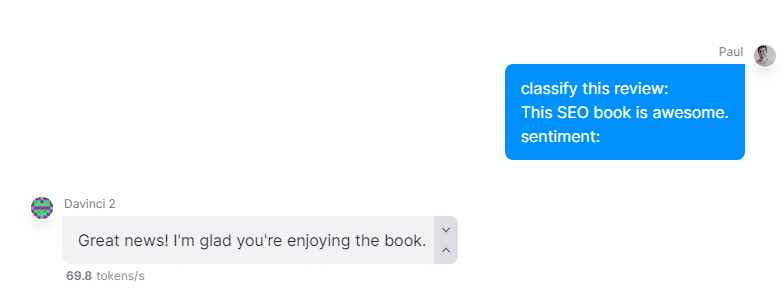
Zero shot on Davinci 2 
One shot on Davinci 2 

Many shot inference

  • Providing several examples helps the AI model understand a range of possible approaches to the task, ideal for complex or nuanced requirements.
  • Example prompt: “Create an SEO-optimized title tag for a webpage about the best chef in Cincinnati, like:
    • Discover the Best Chefs in Los Angeles – Your Guide to Fine Dining
    • Atlanta’s Top Chefs: Who’s Who in the Culinary Scene
    • Explore Elite Chefs in Chicago – A Culinary Journey”

Using the zero shot, one shot, and many shot methods, AI models can be effectively guided to produce consistent outputs. These strategies are especially useful in crafting elements like title tags, where precision, relevance, and adherence to SEO best practices are crucial. 

By tailoring the number of examples to the model’s capabilities and the task’s complexity, you can optimize your use of AI for content creation. 

While developing our web application, we discovered that providing examples is the most impactful prompt engineering technique.

This approach is especially effective even with larger models, as the systems can accurately identify and incorporate the essential patterns needed. This ensures that the generated content aligns closely with your intended goals.

3. ‘Follow all of my rules’ pattern 

This strategy is both simple and effective in enhancing the precision of AI-generated responses. Adding a specific instruction line at the beginning of the prompt can significantly improve the likelihood of the AI adhering to all your guidelines.

It’s worth noting that instructions placed at the start of a prompt generally receive more attention from the AI. 

So, if you include a directive like “do not skip any steps” or “follow every instruction” right at the outset, it sets a clear expectation for the AI to meticulously follow each part of your prompt. 

This technique is particularly useful in scenarios where the sequence and completeness of the steps are crucial, such as in procedural or technical content. Doing so ensures that the AI pays close attention to every detail you’ve outlined, leading to more thorough and accurate outputs.

4. Question refinement pattern

This is a straightforward yet powerful approach to harnessing the AI’s existing knowledge base for better outcomes. You encourage the AI to generate additional, more refined questions. These questions, in turn, guide the AI toward crafting superior outputs that align more closely with your desired results.

This technique prompts the AI to delve deeper and question its initial understanding or response, uncovering more nuanced or specific lines of inquiry. 

It’s particularly effective when aiming for a detailed or comprehensive answer, as it pushes the AI to consider aspects it might not have initially addressed.

Here’s an example to illustrate this process in action:

Before: Question refinement strategy 

Question refinement pattern - Before

After: Prompt after question refinement strategy 
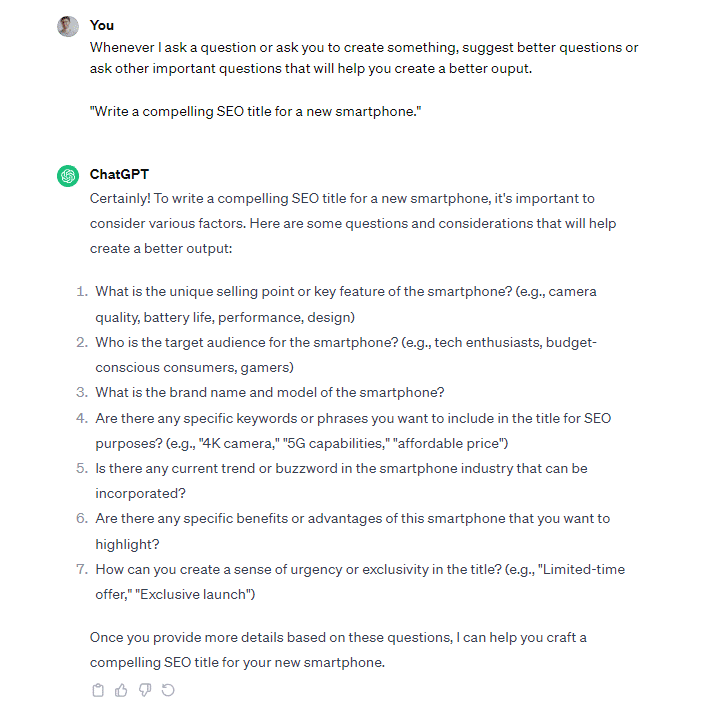
Question refinement pattern - After

5. ‘Make my prompt more precise’ pattern 

The final prompt engineering technique I’d like to introduce is a unique, recursive process where you feed your initial prompts back into GPT. 

This allows GPT to act as a collaborator in refining your prompts, helping you to pinpoint more descriptive, precise, and effective language. It’s a reassuring reminder that you’re not alone in the art of prompt crafting.

This method involves a bit of a feedback loop. You start with your original prompt, let GPT process it, and then examine the output to identify areas for enhancement. You can then rephrase or refine your prompt based on these insights and feed it into the system. 

This iterative process can lead to more polished and concise instructions, optimizing the effectiveness of your prompts.

Much like the other methods we’ve discussed, this one may require fine-tuning. However, the effort is often rewarded with more streamlined prompts that communicate your intentions clearly and succinctly to the AI, leading to better-aligned and more efficient outputs.
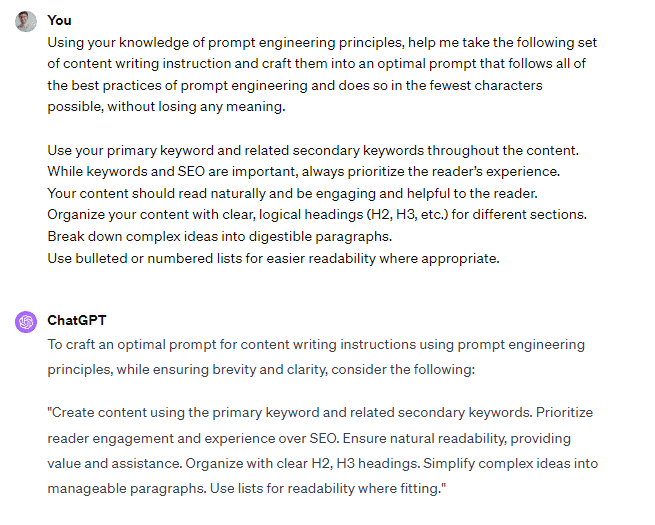
‘Make my prompt more precise’ pattern - 1

After implementing your refined prompts, you can engage GPT in a meta-analysis by asking it to identify the patterns it followed in generating its responses.

‘Make my prompt more precise’ pattern - 1

Crafting effective AI prompts for better outputs

The world of AI-assisted content creation doesn’t end here.

Numerous other patterns – like “chain of thought,” “cognitive verifier,” “template,” and “tree of thoughts” – can augment AI to tackle more complex problems and improve question-answering accuracy.

In future articles, we’ll explore these patterns and the intricate practice of splitting prompts between system and user inputs.


via Search Engine Land https://ift.tt/3nActwT

Google says search result snippets primarily come from page content, not other sources

Google has clarified that the snippets it presents within the Google Search results primarily come from the content on the page and not from structured data or your meta descriptions. Google updated its snippets control help document to clarify this language.

What Google said. Google explained that it “Clarified in our documentation about snippets that the primary source of the snippet is the page content itself.” “The previous wording incorrectly implied that structured data and the meta description HTML element are the primary sources for snippets,” Google wrote.

What changed. Google updated the snippets control help document to change the lead paragraph to say, “Google primarily uses the content on the page to automatically determine the appropriate snippet. We may also use descriptive information in the meta description element when it describes the page better than other parts of the content.”

“Google uses a number of different sources to automatically determine the appropriate snippet, including descriptive information in the meta description tag for each page. We may also use information found on the page, or create rich results based on markup and content on the page,” was the previous wording.

Google also removed all references to rich results in the document.

Why we care. Most of you probably already knew that Google primarily uses the page content for the snippets it shows in the Google Search results. But there are some cases where Google may use other HTML elements for your snippets. But primarily Google will pull that content from what it finds on the visible content on your pages.


via Search Engine Land https://ift.tt/5LNYCeu

Friday, 5 January 2024

94% of Google SGE links are different from organic search results, study finds

The AI-generated answers in Google’s Search Generative Experience (SGE) do not match any links from the top 10 Google organic search results 93.8% of the time.

That’s according to a new Authoritas analysis, which focused primarily on commercial keywords.

Why we care. Google SGE is expected to reduce organic traffic significantly to websites for many keywords because searchers will be able to get the answer directly in Google’s AI-generated answer. The one bright spot? Websites that can’t reach the top 10 of Google’s organic results might be able to appear as links within SGE.

SGE often gives links to content not in top organic results. According to the study:

  • In simple terms, when comparing the URLs that Google’s SGE content generates against the URLs that appear in regular (organic) search results, there’s a relatively low overlap. Only about 4.5% of the time does a URL in the generative content exactly match a URL in the organic results. An even smaller percentage (1.6%) matches at the domain level, meaning the generative content is from the same website as an organic result but not the exact same page. The vast majority of the time (93.8%), the generative content introduces URLs that are completely different from those in the organic search results.

And:

  • “93.8% of generative links (in this dataset at least) came from sources outside the top-ranking organic domains. With only 4.5% of generative URLs directly matching a page 1 organic URL and only 1.6% showing a different URL from the same organic ranking domain.”

Links in SGE. Overall, on average, SGE shows about 10 links, but only about four unique links. Also, the links in SGE answers come from four unique websites. This means that, on average, two or three links in SGE answers point to the same website.

Percentage of keywords with SGE results. SGE showed for 86.8% of the keywords in this analysis. That means 13.2% of keywords failed to trigger SGE content.

  • The Generate button version (where Google asks if you want to generate an AI response) of SGE appeared 65.9% of the time, which was more often than the Show more button format (where Google shows you part of its AI-generated response).

About the study. Data for 1,000 commercial keywords was collected, using data from a logged-in New York-based Google Chrome account holder, over two days in December 2023. It includes keywords in 10 categories:

  • Automotive
  • Ecommerce & Retail
  • Entertainment
  • Fashion & Apparel
  • Finance
  • Food & Beverage
  • Health & Wellness
  • Legal
  • Technology & Electronics
  • Travel & Hospitality

Dig deeper:


via Search Engine Land https://ift.tt/CiAzU34

TikTok ‘planning to rival Amazon with major U.S. expansion’

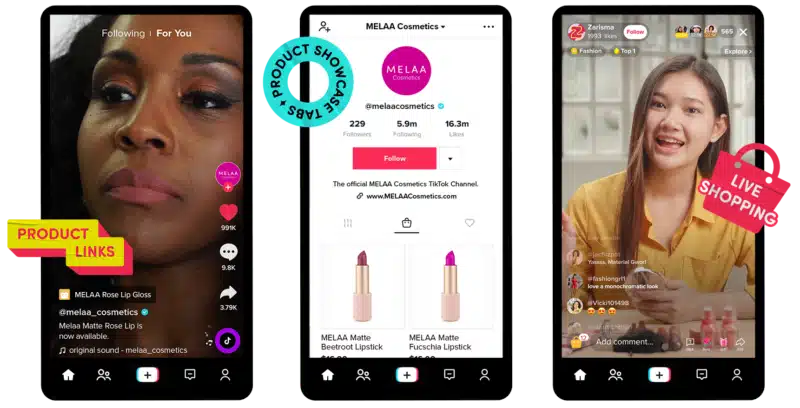
TikTok is reportedly planning to rival Amazon by growing its U.S. ecommerce business, TikTok Shop, tenfold to $17.5 billion this year.

Why we care. TikTok Shop is a prime opportunity for brands as 83% of users make purchase decisions on the platform. If TikTok is planning a major expansion, marketers will benefit from being able to showcase their products to a larger engaged audience in the States, maximizing ROI.

The details. TikTok is preparing to utilize its engaged user base and viral videos to boost merchandise sales on the U.S. TikTok Shop, reports Bloomberg. Although the details of this strategy were recently discussed during internal meetings, it’s important to note that these plans might change depending on the business’s performance.

However, if everything goes as planned, TikTok will pose a challenge not only to Amazon but also to online retail media brands like Temu and Shein.

Why now? TikTok was reportedly on the path to generating approximately $20 billion in global gross merchandise value – although the platform has denied this figure – with the majority of sales coming from Southeast Asia last year. The company is eyeing an expansion of its sales footprint in the U.S. and Latin America. According to two individuals familiar with the matter, TikTok is gearing up to launch its ecommerce operations in these regions in the upcoming months.

What is TikTok Shop? TikTok Shop allows users to make purchases while scrolling through a continuous stream of short videos and live streams within the main social media app. This feature enables both merchants and creators to display and sell products, creating a seamless in-app experience for the TikTok community to explore and buy directly.


Get the daily newsletter search marketers rely on.


Deep dive. Visit the TikTok Shop Help Center for more information.


via Search Engine Land https://ift.tt/gJ6fKnB

Thursday, 4 January 2024

GroupM teams up with YouTube, Disney and NBCU to transform streaming ads

Group M is planning to simplify the buying and placement of ads on streaming services for advertisers.

Through the GroupM Ad Innovation Accelerator program, GroupM is joining forces with BrightLine, Disney, KERV, NBCUniversal, Roku, Telly, and YouTube to develop a new ad format for streaming services. This format aims to cater to viewers who prefer to avoid commercials.

The collaborative effort aims to transform the conventional 30-second ad spot by incorporating advanced digital technologies. This innovation aims to strengthen connections between brands and viewers, delivering measurable outcomes for advertisers partnering with GroupM.

Why we care. This program addresses changing viewer preferences and offers a potential solution for more effective streaming service advertising. It also presents a promising opportunity for advertisers to connect with younger audiences, who are increasingly shifting from traditional TV to streaming services.

What is GroupM?  GroupM, the media-buying division of European advertising conglomerate WPP, is one of the largest investors of advertising dollars in the U.S.

What Group M is saying. Mike Fisher, Executive Director, Investment Innovation, GroupM U.S., said in a statement:

  • “Brands advertising in ad-supported streaming environments have an incredible opportunity to engage with attentive consumers, but the rapidly evolving media landscape makes it difficult for advertisers to efficiently and resourcefully launch interactive advertising campaigns.”
  • “Our clients need a simple way to activate interoperable and attributable campaigns across the ad-supported streaming ecosystem. With key stakeholders at the same table, we will shape impactful outcomes that allow advertisers to execute creative, engaging and effective campaigns.”

Get the daily newsletter search marketers rely on.


Deep dive. Read Group M’s announcement in full for more information.


via Search Engine Land https://ift.tt/a0W98zU

Google has started phasing out third-party cookies

Google has officially started to phase out third-party cookies.

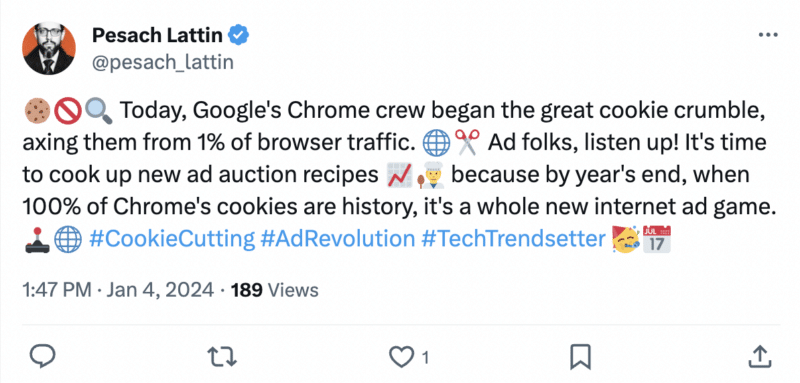
A new feature called Tracking Protection, which restricts third-party cookies by default, began rolling out to 1% of Chrome users globally on January 4, 2024.

If you have been affected, you will will receive a notification when you open Chrome on either desktop or Android devices.

Why we care. If your marketing heavily depends on targeted advertising with third-party cookies, it’s time to reconsider your tactics. Begin preparing your websites now before Google completely retires third-party cookies in the latter half of 2024.

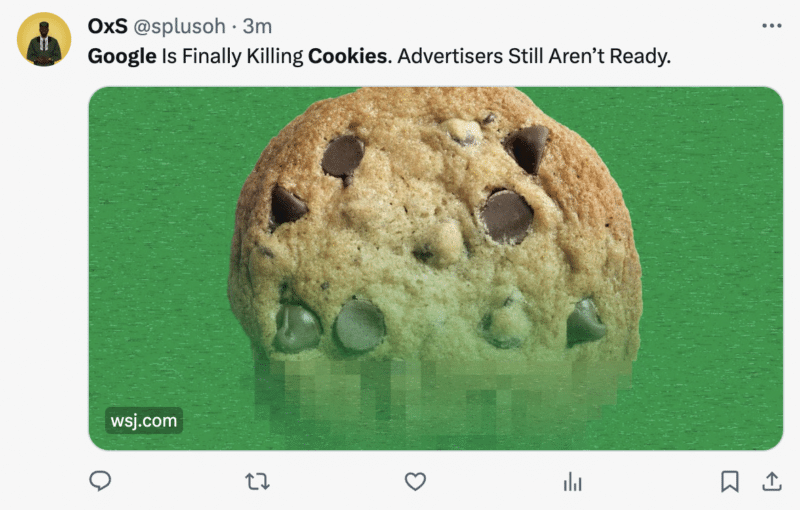
Impact: The affect of the Tracking Protection tool rollout is yet to be determined, however, discussions among digital marketers on X indicate that advertisers are still not ready for the removal of third-party cookies:

Problems to watch out for. If your site relies on third-party cookies and the roll out of Tracking Protection causes issues (for example, you refresh a page multiple times), Chrome will prompt you to temporarily re-enable them by clicking the eye icon on the address bar’s right side.

What are third-party cookies? A third-party cookie is a small piece of data placed on a user’s device (computer, cellphone, or tablet) by a website different from the one the user is currently visiting. It tracks the user’s browsing history, enabling personalized ads based on their activities.

Why now? Google considers phasing out third-party cookies by the second half of 2024 as a crucial move in its Privacy Sandbox initiative. The final decision depends on resolving competition concerns from the UK’s Competition and Markets Authority.


Get the daily newsletter search marketers rely on.


Deep dive. Read ‘SEO and the future world without cookies‘ by Search Engine Land contributor Adam Audette for more information on what a cookieless world will look like for SEO and PPC marketers.


via Search Engine Land https://ift.tt/SvxCG1J

Building a winning Facebook and Instagram strategy for 2024

Advertising on Meta presents unique opportunities that Google Ads doesn’t offer.

Whether your goal is lead generation or ecommerce, Menachem Ani, PPC expert and founder of JXT Group, shared valuable insights at SMX Next on how to optimize campaigns for Facebook and Instagram.

Read on to learn Ani’s seven-step frameworks for building winning lead generation and ecommerce strategies in Meta’s automated landscape.

Meta Ads > Google Ads?

When advertising on platforms like Google, you’re restricted to reaching people searching for your product or service.

However, when placing ads on social platforms like Facebook and Instagram, the possibilities are more diverse, according to Ani. He explained:

  • “There are similarities between Google and Meta ads in the sense that they are both pushing towards automation with fewer levels and less controls. But that’s where the similarities end.”
  • “With Google Ads, you’re capturing existing demand, somebody searching for the product or service – but it’s finite. There’s only a certain amount of search happening for a specific keyword. Whereas with paid social, you can, you can educate consumers a little higher up in the funnel, create demand and then capture it later on.”

Should you spend more on Google or Meta?

A multi-channel approach is usually best but the answer depends on the nature of your business, according to Ani. He said:

  • “If your brand sells products, then Meta will likely work for you. If you’re selling more commoditized products like electronic appliances, then it’s best to lead with Google.”
  • “However, we’ve found that it’s usually best to run campaigns across all channels because it gives you multiple sources of revenue – and diversification is always a good thing.”

Lead generation on Facebook and Instagram

Although Meta ads are probably best known for driving results in ecommerce, Facebook and Instagram ads can also be used to effectively generate leads. The key is to focus on quality over quantity (i.e., leads that will actually convert into sales). Ani explained:

  • “The last thing you want is to generate leads that you can’t sell to. Ultimately a lead is only worth something if it if it can turn into revenue.”
  • “To do this, you need a well thought out strategy to ensure that your message reaches the right consumer.”

The challenge with Meta lead generation

Although lead generation campaigns on Facebook and Instagram can drive great results, you’re also likely to receive a lot of spam leads, according to Ani.

The system tends to optimize for form submissions rather than real-time revenue like in ecommerce, which can result in more leads of lower quality. The challenge is finding a balance to get better quality leads, even if it means fewer form submissions:

  • “Remember that leads are not sales – you can’t deposit leads in your bank account. It’s super important to figure out how to get good quality leads.”

7-step lead generation framework

Ani shared a seven-step strategy to address issues like spam and enhance lead generation results through Facebook and Instagram ads.

1. Leads > traffic

The campaign goal you choose is crucial. The Meta algorithm is powerful but specific.

If you run a traffic-focused campaign, you’ll get traffic – but that doesn’t necessarily translate into leads. To sell and get inbound inquiries, you need leads, Ani explained:

  • “For this, I recommend always using a conversion-focused campaign specifically focused to driving leads based off of your pixel tracking.”

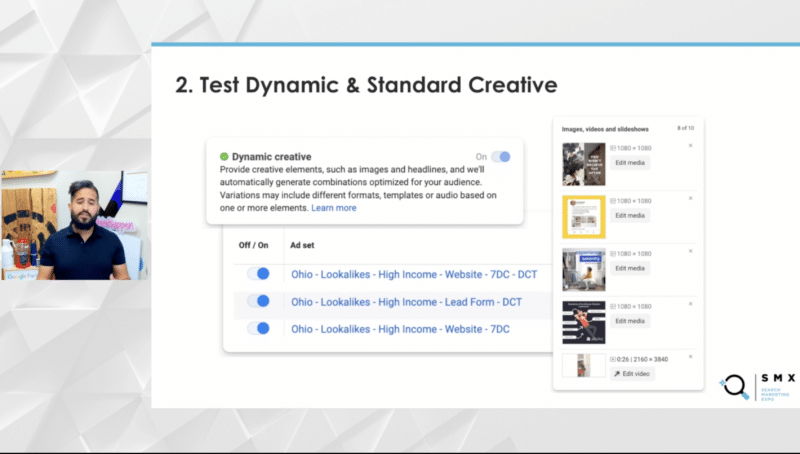
2. Test dynamic and standard creative

When setting up your campaign on Facebook, you can choose to create individual ads or use dynamic creative, which is like responsive search ads on Google – and it’s important to explore both options.

Although testing various targeting and ad creatives is usually advised, dynamic creative works well for smaller lead generation campaigns. Ani explained:

  • “With dynamic creative, you provide a list of ad copy and creative elements (like images and videos), and the system personalizes the ad for each user.”
  • “This is particularly useful for small budgets on lead generation campaigns where you may lack sufficient data to optimize specific ads as it allows the system to algorithmically target users.”

3. Use customer lookalikes and interests

Ani explained that while the pixel is powerful for targeting based on website activity, when it comes to lead generation, especially on newer or smaller accounts, custom audiences can be effective.

Instead of broad targeting, he recommends creating lookalike audiences from your customer list or qualified leads.

  • “Telling the system that people who are interested in x or belong to specific demographics are likely the potential consumer for you can be helpful.”
  • “It’s also a good idea to allow the system to use Advantage+ targeting (which is where it expands outside of your audiences) as an additional 20% or so to find users who may not be in the specific audiences you set up.”
  • “Unlike ecommerce, where the system can see the revenue coming in in real-time, sometimes you need a bit more of a signal and this helps with lead quality because your ads are being shown to more interested users.”

4. Use Facebook and Instagram

Advertisers often try to manually control where their ads appear, but the algorithm is powerful. It’s best to let the system show ads wherever on Facebook, Instagram, and Messenger, according to Ani.

The algorithm efficiently regulates ad placements based on where conversions are happening. So Ani recommends allowing the algorithm to do the heavy lifting.

Limiting exposure with manual adjustments can increase costs and you may miss out on untapped potential, Ani said:

  • “What we’ve learned is that this holds true across most ad platforms today. … When you limit your exposure with manual adjustments, you end up increasing your costs and you lose out on untapped potential.”

5. Think beyond video creatives

Once you’ve identified your audience, the next step is crafting your message.

While ecommerce often emphasizes video creative, for lead generation, image ads surprisingly work well, according to Ani. Video ads are effective too, but creating good videos, especially for lead gen, can be challenging.

Plain images or overlaying text onto an image, like banner ads, are effective. Because your audiences are broad, the messaging in your image ad or the accompanying copy serves as a form of targeting.

6. Create dedicated landing pages

When a user clicks your ad, the destination matters, especially in lead generation. So consider options like sending them to your homepage, a dedicated landing page, or using embedded Facebook or Instagram forms. Ani recommended creating embedded forms:

  • “You’re likely going to get less leads if you use an embedded form, but the leads you do get will be better quality because the ones that were going to be spam are less likely to fill out that form due to the extra effort needed.”
  • “Remember, embedded forms on Facebook and Instagram are pre-populated with the user’s Instagram or Facebook account information. So it’ll have their name, email and so on. And that makes the form a lot easier to fill out.”
  • “I would also recommend adding an additional question to sort of forcefully add friction to the process so that fewer people accidentally fill out the form and you’ll end up with slightly better quality leads – remembering that leads are not sales.”

7. Conversions are not sales

Tracking the source of each lead is crucial. You can add UTM parameters to your ads to see, in real time, which campaign, ad set, and ad creative a specific lead came from.

Over time, by analyzing this data in your CRM, you can establish patterns.

For example, a breakdown of 30 leads from a specific campaign, including their current status, can reveal insights. Isolating and analyzing such data helps identify what’s working well, whether it’s a specific creative resonating with consumers or certain audiences performing better.

This information is valuable for optimizing your future lead generation efforts, Ani explained.

Ecommerce ads for Facebook and Instagram

Ecommerce differs in that the system automatically tracks revenue in real time, according to Ani. This simplifies the process, as a lead often translates directly to a sale.

However, industries with high fraud rates may pose challenges. Tracking revenue in real time lets you assign a dollar value to each order, making it easier to align with profit-centric optimization.

Many direct-to-consumer (DTC) operators use Meta ads and email in their marketing mix. Yet, ecommerce doesn’t have to be purely transactional, Ani said:

  • “You can lean into other campaigns on the Google side, like Performance Max, Demand Gen, YouTube, and so on, to capture additional demand that way too.”

7-point ecommerce framework

Here is Ani’s seven-step guide to drive ecommerce results using Facebook and Instagram ads.

1. Test Advantage+ carefully

Unlike lead generation campaigns, where the primary option is conversion-focused, ecommerce allows for a different campaign type called Advantage Plus Shopping. This automated and algorithmic approach, with fewer controls, is akin to Google’s Performance Max.

Advantage Plus Shopping is broad and less structured than a standard conversion purchase-optimized campaign.

  • “What we’ve found is that you want to try using both [Advantage Plus Shopping and conversion campaign types] and see how it goes.”
  • “For some of our clients, Advantage Plus typically performs better, but for others, we have found that standard purchase conversions work better – but for others, we find a mixture of running them both side-by-side for different products or promotions is best.”

2. Go broad on targeting

For broad targeting in ecommerce campaigns, it’s often effective to let the system go “crazy”, according to Ani. Allow it to target whoever it deems most likely to purchase, excluding recent purchasers, such as those in the last 30 days.

Additional audience limitations can artificially increase CPMs, so it’s generally better to go broad and let the powerful Meta algorithm determine the most promising targets based on real-time revenue data. Trusting the algorithm’s capabilities and leaning into its power tends to yield positive results.

3. Purchase > Add to cart > Clicks

In ecommerce, when running conversion campaigns, it’s crucial to be specific in your objectives.

While the powerful system will deliver what you ask for, specifying actions like “add to carts” or “clicks” might not lead to actual sales. Ani explained:

  • “If you tell it you want clicks, you’re going to get clicks, but they typically don’t convert into sales.”
  • “So if you’re going to run a purchase conversions campaign, make sure you’re focusing on purchases very specifically because you want purchases – you need revenue. Make sure to focus on that.”

4. Trust in seven-day click

In ecommerce, attribution is different from lead generation. While one day is often sufficient for leads, ecommerce purchases may require more time.

Leaning into a seven-day click attribution is generally recommended. This longer period accommodates the full purchase journey, acknowledging that a user who clicks on an ad may not be ready to buy on the same day.

Avoid one-day view attributions, which can inflate attribution figures due to the widespread exposure of ads on Facebook and Instagram. Ani added:

  • “Typically, we recommend using seven-day click attribution unless you’re selling an impulse purchase. In those cases, a one-day click should be enough.”

5. Get creative with creatives

When it comes to creative in online marketing, testing is key, according to Ani. You can experiment with various formats like image ads, video ads, and carousel ads.

Within each type, there are diverse approaches.

  • For image ads, you can try product shots, lifestyle images, comparison visuals, or showcase media mentions and customer reviews.
  • Videos offer versatility, ranging from high-production to user-generated content, testimonials and different lengths.
  • Carousels allow for dynamic catalog ads, providing a range of options.

There’s no one-size-fits-all solution, so it’s essential to test different creative elements to discover what resonates best with your brand. What works for one brand may not necessarily work for another.

6. Match creative cycling to spend

When it comes to testing new creative assets, the focus should be on the traffic flow through a specific ad rather than a specific time or budget. Ideally, you want a significant amount of traffic in the hundreds or even a couple of thousand clicks, to establish statistical significance.

This ensures that the data collected is reliable and can be trusted for making informed decisions. With only a few clicks or orders, it’s challenging to gauge whether the creative will work at a larger scale. Emphasizing the amount of traffic passing through an ad allows for a more robust evaluation of its effectiveness.

7. Keep naming consistent

Maintaining consistent ad naming conventions is crucial for effectively tracking the performance of your creative assets.

By properly naming your ads (including details like asset type, destination, call-to-action, and more), you can easily filter and report on their effectiveness. This approach allows you to compare the performance of different ad types, such as image ads versus video ads or influencer campaigns versus others.

Consistent ad naming ensures that you can quickly and accurately analyze your data to make informed decisions about your advertising strategy.


Get the daily newsletter search marketers rely on.


Key takeaways

Whether running a lead generation or ecommerce campaign on Facebook and Instagram, there are key strategies to consider. For lead gen, focus on:

  • Limiting spam.
  • Precise targeting.
  • Emphasizing the offer.
  • Messaging.

Meanwhile, in ecommerce, allow the system to handle more targeting, placing greater emphasis on creative component testing.

Both Facebook and Instagram are valuable additions to your marketing efforts. However, it’s essential to integrate them holistically into your overall strategy.

As ad platforms become more sophisticated and algorithmic, understanding when to let the system handle tasks and when to intervene is crucial.


via Search Engine Land https://ift.tt/ISHh8oF