As the competition for consumers’ time and attention heats up, promoting true customer loyalty will be more difficult than ever. Staying ahead of the competition means staying in front of the latest trends in consumer loyalty.
Join loyalty leaders from Merkle and Salesforce as they break down the latest trends in consumer loyalty – including findings from Merkle’s 2022 Loyalty Barometer Report – and share ways that companies can capitalize on these trends to create deeper, more profitable relationships.
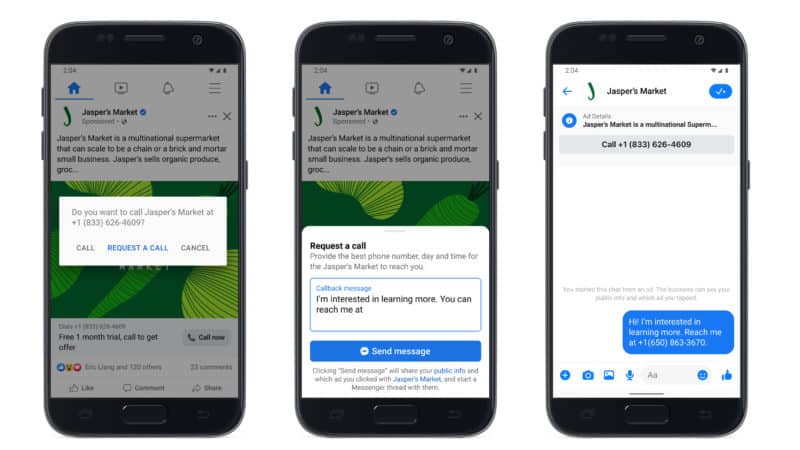
Meta just announced 5 new updates to their call ads. The new updates are intended to help businesses build better customer relationships, find more quality leads, and reach more potential customers to grow their business, they stated in a blog post.
1. Get a callback
This feature is currently being tested and gives customers the option to request a callback from a business.
2. Call Ads in Sales Objective
Businesses will now have the option to include call ads as a format under the Sales/Conversions objective in Ads Manager.
3. 60s call in Lead Gen, Traffic, and Sales objectives
Meta has a added a 60-second call optimization option in lead generation, traffic and to-be-released sales ad objectives to allow businesses to optimize their ads to reach people who are most likely to engage in a longer conversation.
4. Pre-call business feature in Ads Manager
Businesses can provide additional context in ads to help educate potential customers to help them make informed decisions before they make a call.
5. In-app calling
Meta is testing a platform calling solution to enable businesses to connect with customers wherever they are browsing and allow them to continue that same experience within the app after the call is complete. Meta says that no call information is captured.
Dig deeper. You can read the blog post from Meta here.
Why we care. Advertisers and brands on Meta such as stores, restaurants, or service-based businesses should make sure their phone numbers, business hours, and answering messages are up to date so they can be reached by potential customers utilizing these new features.
There’s no indication that these new features will increase the number of leads a brand is receiving. As with every new feature, test the optimization and reporting options to ensure they support your goals and conversion objectives.
With the holidays fast approaching, Google decided it was a good time to announce nine new shopping tools and features. During the announcement, Google said the intent was to drive a more immersive, personalized experience. Let’s dive in.
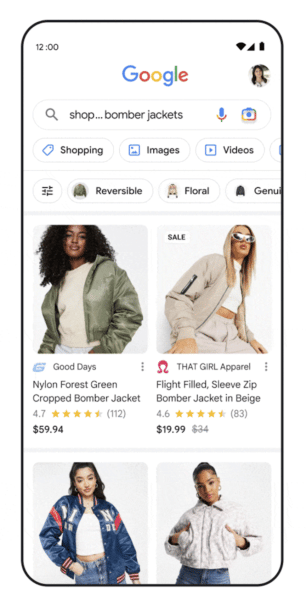
1. Search with the word “shop”
In the US, when you search for the word “shop” followed by the item you’re looking for, you’ll access the visual feed of products, tools, and inventory for that product. The shoppable search experience is also being expanded beyond apparel to electronics, beauty, and more, to additional regions for both mobile and desktop.
2. Shop the look
This new tool will allow you to see options of where to buy the products you see in search. The “shop the look” feature show links to the exact product you’re searching for, plus complementary pieces and where to buy them.
A new feature in Search, trending products shows you products that are popular right now in a specific category. U.S. shoppers will be able to use the new feature later this fall, but no specific date has been provided.
4. Shop in 3D
Google says people engage with 3D images almost 50% more than static ones. 3D visuals of home goods were launched earlier this year, and soon you’ll be able to see 3D visuals of shoes, starting with sneakers.
To give merchants and advertisers better access to 3D visuals, Google also launched a new automated 360-degree spin feature that can be accessed by using a “handful” of static photos. The new technology will become available in the coming months.
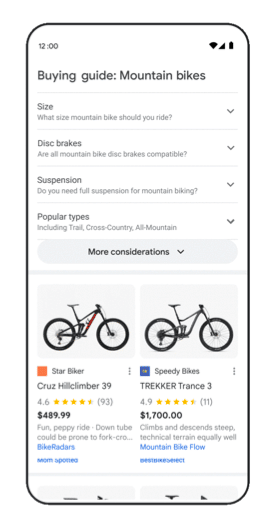
5. Get help with complex purchases
A new buying guide will share helpful insights about a category from a wide range of trusted resources. If you’re purchasing a large or expensive item, the buying guide may show you specs about weight, materials, features, sizes, and more.
The new buying guide recently launched in the U.S. and new insight categories are “coming soon.”
6. See what other shoppers think
A new feature in the Google app gives you helpful context about a webpage you’re on or a product you’re searching like pros and cons, and star ratings, all in one view.
Page insights will launch in the U.S. in the coming months.
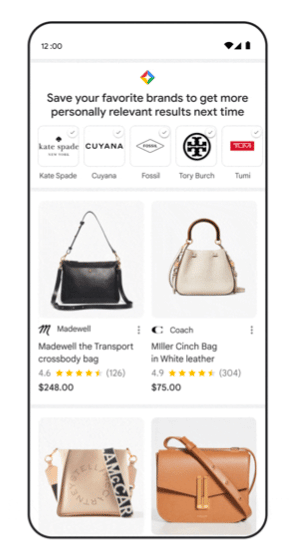
7. Get personalized results
You’ll soon see more personalized results based on your previous shopping habits. You’ll also have the option to set your preferences and turn off personalized controls.
When you’re shopping on Google you can make your selections on preferred stores and brands to see more of those in the future. If you no longer want to see those personalized results, or your preferences change, you can adjust that feature or even turn it off completely.
Get the daily newsletter search marketers rely on.
Whole page shopping filters on Search are now dynamic and adapt based o real-time Search trends. For example, if you're searching for jeans, you could see filters for "wide-leg" and "bootcut" because they're popular, but even those could change over time.
Dynamic filters are available in the US, Japan, and India, and will be launched to more regions in the future.
9. Inspiration beyond the Search box
Using Discover in the Google app, you'll see suggested styles based on what you've been shopping for, and what others have searched for too.
Dig deeper. You can read the full announcement from Google here.
Why we care. Advertisers gearing up for the holiday season should ensure that their ads, images, merchant accounts, and stores are ready for these new features. Shoppers will have more choices, styles, and stores to choose from, so retailers will need to step up their game if they want to stand out.
As we’re approaching a time when many companies are having meetings in their conference rooms to determine budget allocations for the upcoming year, I want to help further the case as to why SEO should have a voice in the room (and budget in your marketing plans).
But first, let me address a bit more why I feel SEO doesn’t get its fair shake.
Proving the value of SEO is complicated
SEO can be a challenge for some in marketing departments to wrap their heads around. There are many moving parts and it’s not as easy as PPC when you understand exactly how that works.
With PPC it’s generally a matter of:
Choose keywords.
Write/ place ads.
Pay when someone clicks.
Send that click to a landing page of your choosing.
Report on results (sales/leads).
It’s true. SEO is more complex than this. And, because of its complexity, I will often instruct prospects to think carefully about not just when to invest in SEO, but whether SEO is even a really viable investment in the first place. Often, the answer to these questions is “it depends.”
Remember, an investment in SEO doesn’t just revolve around hiring an agency or an individual in-house to oversee and drive the strategy.
Unlike PPC, there are many other considerations, including:
Web design and development that may be required, such as:
Creating a new architecture / navigational structure.
Creating new page templates to better support SEO.
Creating a blog/resource section on your website (if you don’t already have one).
Content, such as:
Page content.
Resourceful content.
Thought leadership, white papers or webinars.
PR and legal reviews:
Ensuring that content meets with company compliance needs (especially for medical/pharma/legal/insurance industries and other highly regulated industries).
Case in point: My agency has a client who’s engaged us to aid in the re-structuring of their website (including an audit of their existing presence versus that of a competitor).
The work coming out of this audit resulted in 130 hours worth of web development requirements this client needs to see through to completion in order for the investment that they’ve made with us to be substantiated.
I highly recommend that you consult with a trusted friend/partner who has experience in SEO to help you to make this determination. Many SEOs (the nice ones ) would be happy to provide a free analysis/opportunity assessment. Take advantage of the advice.
Today, I’m going to assume that we’ve determined that there is an opportunity for SEO to provide value for your business. Undoubtedly, if you’re in the conference room trying to determine what – if anything – to budget for SEO, you will want to better understand:
The size of the opportunity.
The size of the investment needed to get you there.
Get the daily newsletter search marketers rely on.
When determining the "value" of an SEO effort, there are two sides to the coin.
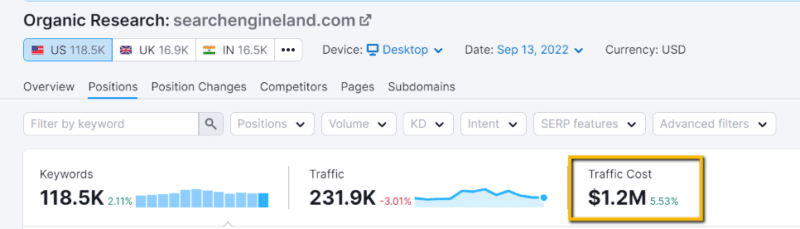
One easy metric is to consider "replacement cost" of the traffic. If you were to buy this same traffic via PPC (that you’re considering targeting via SEO) what would it have cost? Semrush makes this available via their "Traffic Cost" metric:
This can sometimes be a big number, as we see for Search Engine Land. You may find that many of your competitors are realizing this kind of value, yet you aren’t.
That may be as far as you need to go to make your case to the board that SEO is "worth the investment." That’s one way to measure it.
Understanding the traffic potential of SEO efforts
But if you’re a mature marketer, you will try to move beyond just "click value" to something more meaningful.
Tangible value.
Sales.
Leads.
Downloads of white papers.
Sign-ups for webinars.
How you measure this will depend upon whether your business is ecommerce or B2B/lead gen. For both verticals, you'll need to do two things:
Identify the possible keywords that you’ll want to target.
Determine what it might take to compete (i.e., site structure/link acquisition).
Since I’m assuming that you’re a marketing head and perhaps not an SEO, here’s how I would quickly suggest you conduct this type of assessment.
Using Semrush (subscription required), navigate your way to the Organic Research section. Here, you can enter the domains/website addresses for direct competitors who you believe are doing well with their organic presence.
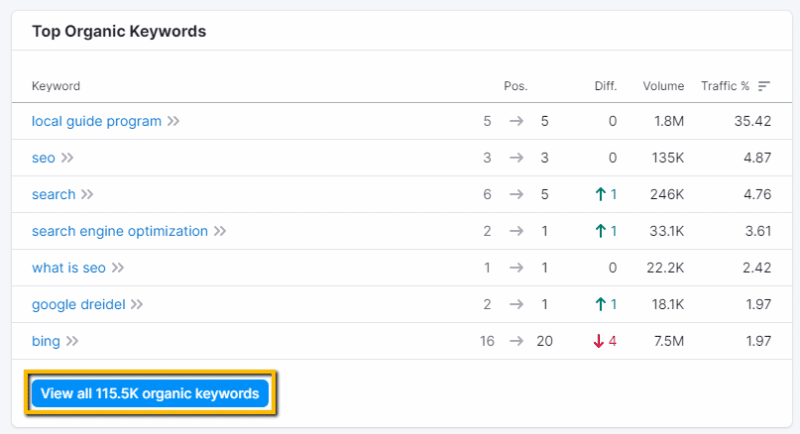
Once you’ve found a competitor who appears to have a significant organic presence, click into the Top Organic Keywords section and click View all organic keywords.
You will now see a complete list of your competitors’ keywords. But this will also include your competitors’ "brand" keywords (their company name, etc.). You need to filter this:
Still, though, this data isn’t great. It’s showing us any keywords that our competitor is ranking for within Google’s top 100 results.
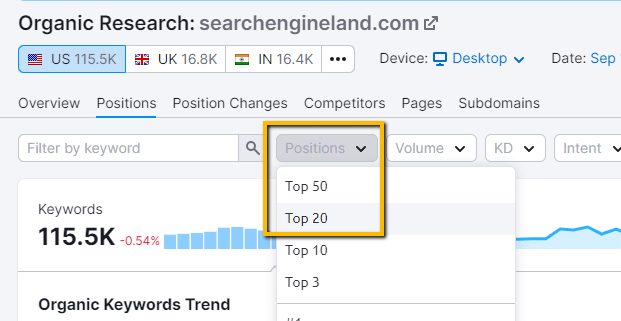
Let’s make this more meaningful/useful by reducing that number down to rankings "which matter" (that’s a subjective metric). In this case, I’m going to only concern myself with the top 20 ranking keywords:
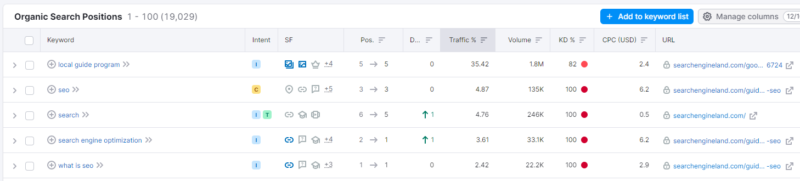
Now I have a workable list of keywords that I know are driving significant organic search traffic to my competitor(s):
This shows me that:
There are 19,029 keywords ranking in Google’s top 20.
The "local guide program" is driving a large share of traffic to my competitor.
The "seo" keyword would have cost me approximately $6.20 cost per click if I were to buy that traffic via Google Ads.
And, as mentioned previously, we can see the "value" of this competitors’ non-brand organic traffic, based on the "replacement cost" ("Traffic Cost"):
If you’re highly ambitious, this is the next step that you can take. Download the Top 20 Rankings list into a spreadsheet.
Create columns into your spreadsheet to make some assumptions (i.e., Ranking Top 3; Ranking 4-7; Ranking 8-10; or you may want to get as detailed as to estimate each top 10 position).
Since we have the estimated monthly search volume for each keyword, you can now multiply those numbers by the potential click-through rate of each potential/future rankings.
SEO is an imperfect science. But this at least gives you some visibility into the traffic potential that exists for an investment. In short, it puts some math into the projections.
Assessing SEO opportunities in ecommerce and B2B/lead gen
Now that you have at least an idea of the traffic potential, we need to break out the tasks for determining what potential "real" value might exist, in terms of things that are more tangible (sales/leads, etc.).
For the purposes of this article, I’ll be focused on either an ecommerce website or a B2B/lead gen website.
Ecommerce opportunity assessment
If you’re an ecommerce website, you should have a general sense of:
Conversion rate into a sale.
Average (net) value of a sale.
Knowing these things, you can run some estimates on how much you might make based upon varying degrees of traffic increases.
For instance:
10,000 visits per month x 1.5% conversion rate into a sale = 150 sales.
150 sales x $300 average net value of a sale = $45,000 per month.
Knowing this potential real value, you can then assess if the investment that you believe will be required in an SEO effort is "worth it."
B2B/lead gen opportunity assessment
If you’re B2B/lead gen, you should have a sense of conversion rate into a lead (and hopefully you’re tracking form submissions, phone calls, chat/messaging apps and other "leads"/conversion types).
Working with this and your internal data on conversion rates from lead to qualified lead and qualified lead to sale, you should be able to calculate the potential ROI.
Taking the same traffic potential above (10,000), here’s what that calculation might look like:
10,000 visitors x 5% conversion rate into a lead = 500 leads.
Let’s say that ½ of those leads are qualified (500 x .5 = 250).
Then, let’s say that we convert 40% of our qualified leads into a sale (250 x .4 = 100).
So, we have 100 potential sales from the SEO investment.
What’s our average net value of a sale?
Every business is different. We have a client whose average net value of a sale is $400,000. That makes the ROI argument pretty easy to make.
But let’s say that your average net value of a sale is $400. With 100 sales x $400, that’s $40,000 in net value from your SEO investment.
Knowing this, you can determine how much you can profitably invest into an SEO effort.
Putting the math in SEO
These formulas are far from perfect. But they provide an opportunity to put math behind what you’re asking for in an investment into an SEO effort.
You should also caution those involved that SEO is not a quick fix. It may very well be that you’ll spend the first months of the effort in deep research before big changes occur.
As mentioned above, other hard (internal) costs could be involved, such as a restructuring of your website, content additions, page additions and PR/thought Leadership items. Do your best to account for these things.
While there are certainly times when I have strongly recommended against a company investing in an SEO effort, it’s more often that you’ll know me as a champion of the channel.
Before purchasing, your customers always look for reviews and references to reinforce and validate their intent.
In the U.K., I worked with an agency that served 600 small businesses of which a large percentage were florists. A flower shop customer’s intent can be one of the following:
Look for seasonal flower arrangements (Valentine’s, Mother’s Day, etc.).
Type of flowers to buy for a dinner date.
Learn how to make a Christmas wreath.
Wedding flower services.
When a potential customer has a clear intent, two things can happen:
They will start their influence journey on TikTok, Instagram or YouTube. Looking at videos to seek inspiration on flower arrangements or the most appropriate flowers for specific occasions.
Go straight to Google to type one of the following queries:
Flower Delivery + location
Same day flower delivery
Same day flower delivery + location
Wedding flower services
Flower subscription services
And it is here where a well-optimized Google Business Profile (GBP) can become a significant source of influence because of its reviews, information, images and products.
An enhanced GBP drives more leads from your listing even though you’re not ranking as high as other listings. Optimize the following elements to turn your Google Business Profile into a revenue-generating channel.
1. Info section: Categories
The category chosen considerably impacts the rankings at the local level. Your company’s primary categorization explains what it performs (i.e., law firm, dentist, plumber, hair salon, etc). Furthermore, this will be the sole category accessible to the entire public.
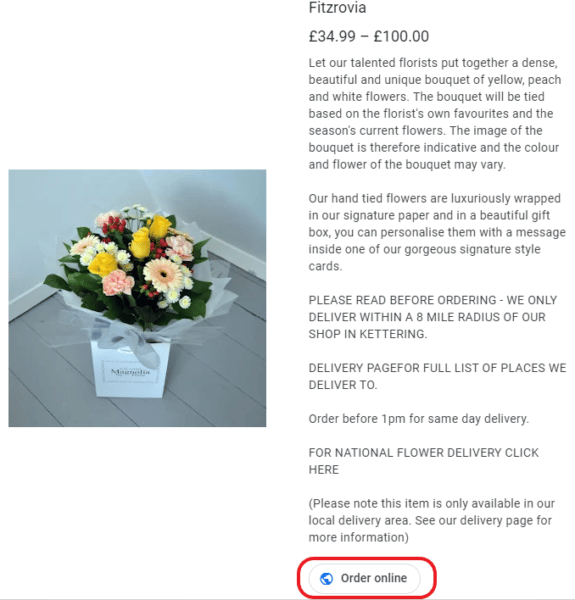
In the example below, the primary category is “Florist” and the additional category is “Flower delivery.”
2. Reviews
About 77% of consumers “always” or “regularly” read online reviews when browsing for local businesses, according to BrightLocal’s recent survey.
Reviews are an increasingly important ranking component and a conversion factor. They are crucial to local businesses, not only to stand out but to build credibility.
Google will emphasize reviews for branded searches and display them prominently on your company profile.
Another important aspect of reviews is always replying, which encourages customers to leave reviews and increases your credibility.
Reviews may bring in additional consumers, provide insightful criticism, and reveal problems or successes in the customer service department.
When updated regularly, the Products section can be a powerful lever to generate revenue. It is placed higher up than the Services category so it is more prominent.
In this section, you can include:
Images.
Call-to-action buttons.
This gives you an opportunity to match your customers’ search intent with relevant products, making it easier and faster for them to reach a purchase decision.
Did you know you can add products at the top of your local and map listings? You can find out how to do it here.
4. Images
Images heavily influence customers during their research phase before purchasing. Google is making information more useful, allowing users to do searches with images and text and get relevant results.
However, adding images (especially logos) to the Image section of your GBP can be tricky. Ensure the pictures you upload for your products, logos, and general imagery are high resolution.
Publishing posts on your Business Profile provides an excellent opportunity to promote new products, events, workshops or special offers.
You can add call-to-action buttons on your posts to help increase transactions and revenue and most of all, make it easy for your customer to complete a purchase.
Posts should not be used to turn keywords into topics and create unhelpful content to influence the search result pages. It will not work, and this practice is considered spam.
Instead, your posts should be brief, concise, informative and useful to your customers.
6. UTM tags
UTM tags are crucial to track precisely how many visits, transactions and revenue your Google Business Profile drives to your website.
Now go to the info section on Google Business Profile and paste the URL you just created on the blank space with the earth icon (which stands for a website).
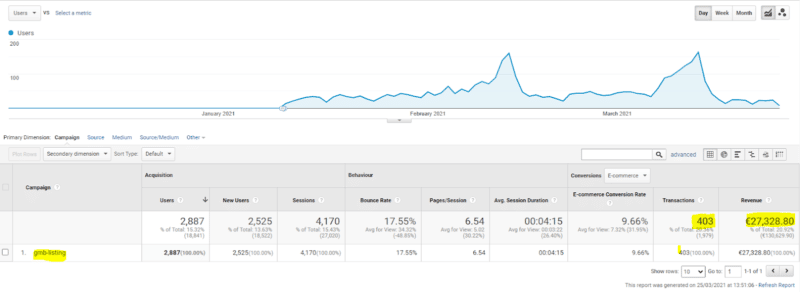
Then if it doesn’t have any errors, it should start tracking and, in a few days, you will be able to see its data on Google Analytics. To see its data on GA, go to Acquisition > Campaigns > All Campaigns.
Then you will be able to see all the campaigns. Look for “gbp-listing.”
Case study: A local flower shop
Magnolia’s is a lovely flower shop in a gorgeous village in Northamptonshire in the U.K.
On Jan. 15, 2021, just before the big season (Valentine’s, Mother’s Day and Easter), I helped them make some improvements to their Google Business Profile, such as:
Improving their information section.
Adding products and categories based on most sold products and most searched products and services.
Starting to publish posts to keep their customers up to date regarding new product launches, upcoming flower workshops and offers.
From zero in revenue at the beginning of January 2021, Magnolia generated €27,328.80 (roughly the same in dollars) in sales by April 2021, just from their Google Business Profile.
What to avoid on Google Business Profile
Keyword stuffing
Adding keywords or cities to your Google Business Profile name is unnecessary unless your business is registered as such.
Additional keywords will not have any influence whatsoever on local rankings or organic listings. Remember that anything we do on GBP will not affect other listings and vice versa.
Important note: If you have keywords on your business name, read this post on Google’s Vicinity Update, the largest update on local search in five years that rolled out in November 2021.
Sectors such as lawyers, insurance and dentists experienced significant fluctuations. Businesses that ranked in areas far from their locations and had keywords in their name were negatively affected.
There is a huge myth that adding keywords to your business description (on the info section) will impact visibility and local rankings. This is not true, and it’s simply a spammy practice.
Make sure your business descriptions are concise and contain information that will be helpful for your customers to know.
Google is not Instagram or Twitter, so hashtags will be completely useless and look bad on your content for GBP. They don’t have any effect on discoverability and local search.
Staying relevant in an increasingly crowded digital world requires you to focus on and drive the metrics that matter most while staying a step (or two) ahead of your competitors. Search marketers like you know that achieving this level of success requires training with trusted experts who are eager to share what it takes to win.
Join some of the world’s most respected search marketing minds at SMX Next – online November 15-16 – to explore next-level SEO and PPC topics, trends, and tactics… all without leaving your desk, and all for free.
Your free All Access pass unlocks the entire program, featuring 45+ tactic-rich sessions, two exclusive keynote discussions with Google, invaluable live Q&A during Overtime, morning “Coffee Talk” networking discussions, and a personalized Certificate of Attendance.
The agenda will be posted on October 10… in the meantime, click below for your exclusive agenda preview!
Instant on-demand access is included with your free pass – so you can participate any time that fits your schedule. No plane ticket. No expense report. No kidding.
Join the ranks of more than 150,000 search marketers who have trusted SMX to deliver actionable tactics and expert insights that drive measurable results. Secure your free spot now!
With high inflation and low consumer confidence, plus the lingering effects of the supply chain crisis, nobody knows quite what to expect this holiday season. But one thing is for sure: if you want your business to succeed, you need to be prepared with relevant, connected experiences across every customer interaction.
That’s where AI comes in. Join experts to learn how to help your marketing stand out among the crowd.








 ) would be happy to provide a free analysis/opportunity assessment. Take advantage of the advice.