Friday, 27 October 2023

How to approach weekly, monthly, quarterly and annual PPC reporting

Paid media professionals are no strangers to reporting. 

However, not all PPC reports should be treated the same. 

  • Different audiences require you to focus on different metrics, and who receives your report should dictate the type of analysis you put together. 
  • Reporting also varies depending on the time frame you review, with the most common cadences being weekly, monthly, quarterly and annually. 

Each report has key similarities and differences, so let’s dive in. 

Effective analysis overview

First, a quick refresher on how to effectively analyze PPC performance:

  • Note any shifts in key metrics, especially spend and conversions. 
  • Explain what those shifts mean in the real world. 
  • Call out the potential causes behind any trends. 

The result is a clear overview of what’s happening in the account, why it’s happening, and what you did to influence that (or how you plan to address it if action is needed).

  • Example: “Conversion rate increased 10%, which indicates that our landing page resonates better with our audience after updating the content two weeks ago.” 

This general approach is relevant for any report, regardless of audience or cadence.

Dig deeper: PPC management checklist: Daily, weekly and monthly reviews

Weekly reports

A weekly cadence is usually the shortest duration people are asked to report on. The audience for these reports might be your regular point of contact or a direct manager so that the analysis can be more in-depth. 

For accounts with a high volume of data (which may also coincide with higher budgets), it’s fairly common to see trends appear week over week. 

  • Call these out, any reasons for the shifts, and any action items that might be needed. 
  • You can also provide a quick month-over-month comparison to look at the broader picture.

For accounts with lower budgets or less data available (like if you target a niche industry), week-over-week shifts might not be as prevalent. 

  • Try not to overreact to minor shifts in this situation, as data could be skewed by the short time frame you’re looking at.
    • Example: 2 conversions last week vs. 3 conversions the week prior is a 33% decrease, but the overall volume is similar. A 33% decrease for an account averaging 100 conversions per week could be much more alarming though.
  • Instead, I recommend looking at a month-to-date comparison to the previous month to give you a better idea of how performance is trending over time (e.g., 10/1–10/12 vs. 9/1–9/12).
    • You could also compare to the previous period if it’s longer than a week (e.g., 10/1–10/12 vs. 9/19–9/30). 

The biggest differentiator for weekly reports is that you can dig deeper into the account. Hone in on specific keywords and audiences that are seeing a shift. Note any recent changes you made or tasks you’re actively working on to improve short-term performance. 

  • In other words, get a little more into the nitty gritty. Since you’re probably delivering this to someone you work with often, they don’t necessarily need to be reminded of the longer-term goals every week (though that should still be kept in mind). 

These same principles apply if you do biweekly or mid-month reporting instead of weekly reports, and the final product may look something like this:

Example of weekly report for high-volume account
Example of a weekly report for an account with limited data

Monthly reports

Monthly reports should be a staple for any digital marketer. Your audience is likely the same as weekly reports, but they could also be sent to other stakeholders you don’t work with frequently.

Start by comparing performance to the previous month and provide insights based on that month-over-month data. You don’t need to go as in-depth as a weekly report, though – broaden your focus to what had the most impact.

  • Example: Instead of highlighting specific keywords/audiences, call out the ad group or campaign. 
  • There may be times when you need to provide more detail, particularly if performance worsens, but in general, this can serve as a good framework. 

Once you’ve done a month-over-month comparison, compare your performance to the previous year. Are you beating last year’s benchmarks? If not, why? This is a great way to hold yourself accountable and identify opportunities for the future. 

  • Year-over-year analysis can also be fairly brief. You still want to give insight into changes that are impacting performance, but a quick summary should suffice. 

The key with monthly reports is to analyze performance with medium- and long-term goals in mind. People receiving the report don’t necessarily need to know the fine details – just the key points. 

  • Example: Noting that you updated ad copy and CTR increased overall instead of listing each individual headline change. 

The final product may look something like this:
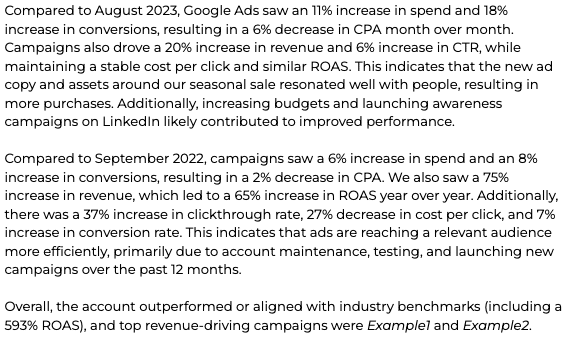
Example of September monthly report

Get the daily newsletter search marketers rely on.

Processing…Please wait.


Quarterly reports

Another common reporting time is at the start of each quarter. Similar to the difference between weekly and monthly reports, these analyses should have a longer-term perspective. 

However, quarterly reports are also more likely to be viewed by higher-ups, like VPs, Directors, and C-level executives. It’s important to approach these like an executive summary because of this. 

In your analysis, focus more on the account's long-term strategy, profitability, etc. Executives likely aren’t as worried about efficiency and engagement metrics (like click-through rate and average cost per click) unless those were defined as core KPIs or had a major contribution to overall account growth. 

This is especially true for any charts, graphs, or other visualizations you include in the report.

The comparison period should also be the previous quarter and the previous year.

  • Example: If you’re doing a quarterly report for Q4 2023, compare that to both Q3 2023 and Q4 2022.

The final product may look something like this: 
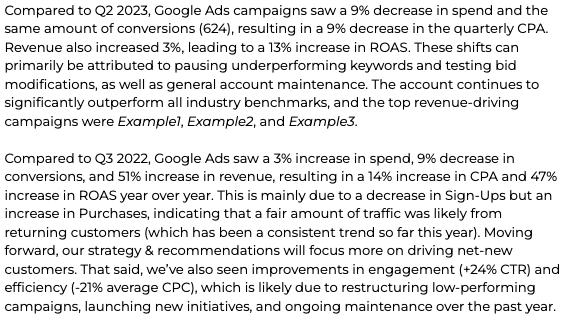
Example of Q3 report

Annual reports

Lastly, annual reports can be used to summarize major initiatives throughout the year. The people you deliver this to will likely be similar to your quarterly reports, so the approach should also be similar. 

The main emphasis should be whether or not company/department-wide goals were achieved. 

  • Compare performance to the previous year and note any major wins or areas for improvement. 
  • Outline your highest impact initiatives from the past 12 months, what went well, and what you would have done differently. 

This gives you a roadmap for the coming year while also highlighting success, and the final product may look something like this: 

Example of 2022 report

Tailoring your PPC analysis: Insights for every reporting cycle

Effective PPC reporting is a matter of timing and audience. Tailoring your analysis to the right timeframe is essential.

The biggest difference between weekly, monthly, and quarterly reports is the amount of detail you should go into. 

  • Weekly reports are the most in-depth, focusing on specific short-term updates.
  • Monthly reports are crucial to understanding medium- and long-term performance, with slightly less detail needed than weekly reports. 
  • Quarterly reports take a higher-level look at key trends unfolding throughout the year.
  • Annual reports summarize major initiatives, with the main emphasis being on company/department-wide goals for the year. 

Clarity, relevance, and actionable insights are key to PPC reporting success. Connect data to real-world implications, speak your audience's language, and refine your reporting skills to make a difference in your paid media efforts.

Dig deeper: How to improve PPC campaign performance: A checklist

The post How to approach weekly, monthly, quarterly and annual PPC reporting appeared first on Search Engine Land.


via Search Engine Land https://ift.tt/tRC6Sfl

Google Ads best practices: The good, the bad and the balancing act

PPC best practices come from a variety of places. Some of those sources are:

  • Google Ads reps.
  • The Help Center.
  • Official certifications.
  • Auto-apply and manual recommendations.
  • Ad strength recommendations.
  • And even automated assets to an extent.

However, depending on those sources, you could end up with highly different answers. So, how do you know when to apply or be critical of a “best practice”?

Many PPC professionals can relate: You see “Google” on your caller ID, and you momentarily feel a boost in ego.

But reality sets in when you realize it’s often a junior Google representative or even a third-party service who needs to tick some boxes to meet quarterly goals, not necessarily tailored to your account’s context. This conflict of interest makes whatever “best practice” they recommend risky.

In the end, you hang up and realize our role as advertisers is to make sure we deliver the highest results with the smallest budget possible. And Google Ads’ role (or any other ad network) is to get you to spend more.

So naturally, our relationship with Google Ads’ best practices has to be balanced. Let’s explore the most common pitfalls and also recognize when Google Ads does a fantastic job.

Leverage automated bidding

There are probably just a few people left who can still successfully run manual CPC campaigns – and that’s a good thing. Look, I know the PPC community is angry at Google for raising ad prices, and some even go as far as saying that automated bidding strategies are only meant for having advertisers spend more. 

But still, anyone who ran proper A/B tests back in the day knows that correctly set up automated bidding strategies outperform manual bidding 99% of the time.

I’m happy Google Ads rolled them out and made a great tool almost 10 years ago. It’s a best practice you can apply almost every time.

Why do I say “almost” though? If Google Ads could clarify optimal setups (conversion density, latency, frequency, etc.), it would be perfect. Right now, the only thing we have is:

When you have little to no conversion data available, Smart Bidding can still use query-level data beyond your bid strategy to build more accurate initial conversion rate models.

– “How our bidding algorithms learn,” Google Ads Help

So if you feel like your automated bid strategy doesn’t quite perform as you’d like to, review the above parameters, but otherwise, you most probably should move away from manual CPC.

Grow with broad match keywords

Just like automated bidding, automated targeting (that’s pretty much what broad match is these days) is getting really good. As such, I believe Google Ads is right to push those broad match types harder. 

There are plenty of studies showing how broad match keywords outperform phrase match keywords. It certainly helps speed up PPC staff training and streamline campaign maintenance with lighter campaign structures. So what’s not to like?

Similar to automated bidding, though, I would still caution against using such a match type blindly. For example, I strongly advise against turning on:

Why is that? Because just like automated bidding, Google Ads hasn’t shared details on optimal setups.

By experience, you want to fuel your bid strategy with some initial down funnel data (purchases) before trusting Google’s AI. Otherwise, just like any AI, it will produce superficial results because it will not see past the top-of-funnel KPIs (pageviews, etc.).

Another recurring theme is the progressive removal of information. As usual, these days, citing privacy allowed Google to limit search term reporting.

While performance is definitely getting better with broad match keywords, visibility isn’t. A shame since search term reports helped better inform holistic marketing decisions.

Growing with broad match keywords is an interesting best practice. But you should be aware of its limitations.


Get the daily newsletter search marketers rely on.

Processing…Please wait.


Upgrade to data-driven attribution

You start to notice a theme right? Data-driven attribution (DDA) is yet another AI-driven innovation from Google. And just like the previous best practices, it sure has value. But also limitations.

Perhaps most importantly, DDA shows marketers that cross-channel journeys actually happen. By nature, distributing conversions across several audiences improves overall performance since it’s more granular and less angular.

However, I believe Google strongly lacks transparency on this one (I mean, even more than for auto bidding and broad match types).

Indeed, you cannot see conversion paths per user cohort. You used to be able to compare DDA to other attribution models, but that’s now gone.

The only other option we’re left with is last-click attribution which is notoriously simplistic (depending on your purchasing journey).

In the end, it’s a great feature, but it shows the early signs of Google’s dark side: it doesn’t care about your context and thinks poorly of you, the advertiser. Don’t get me wrong, I love processing and automating stuff whenever possible. And AI is a fantastic tool.

However, thinking that everything is measurable is a sin, even in data marketing.

What if your purchasing journey isn’t correctly reflected in data available to Google Ads’ algorithms for whatever reason? What will DDA base its conversion distribution on? Your guess is as good as mine.

So while I believe most advertisers should follow this best practice, I believe we should all be very much aware of its limitations – and cross-reference DDA results with other attribution or incrementality results.

Adopt Performance Max campaigns

This best practice aligns with broad match keywords, DDA and automated bidding. But it goes even further: the promise is to identify the perfect media mix for you, thanks to Google’s AI. The shocking part is that it can totally deliver.

So why am I ranking that best practice with an orange traffic light?

Because:

  • Most advertisers are simply not ready to embrace such a tool.
  • Tracking is too often limited to revenue for ecommerce clients and MQLs for lead gen clients – no sense of LTV or profits.

Another hole in advertisers' toolkits often can be found in data pipelines:

  • Conversion volumes are too weak.
  • Freshness doesn’t mean a thing to traffic managers.
  • Frequency is a nice-to-have instead of a must-have.

Ultimately, Google Ads’ Performance Max algorithms will deliver impressions approximately.

Remember: their output can only be as good as the input you feed it. Do you think your setup is strong enough to feed such a beast?

So when your favorite Google Ads’ rep tells you to switch everything to Performance Max, think again. Do you tick all these boxes:

  • Do I feed Google Ads with revenue data, at the very least?
  • Do I have a purchasing journey that’s short enough?
  • Is my business’ current media mix mostly based on non-branded and non-retargeting traffic?
  • Am I ready to give up on lots of valuable marketing insights?

There are naturally a lot of other questions you could ask yourself, but those are the main ones to me. Adopting Performance Max is not a straightforward best practice, as you can see.

Being critical: Best practices vs. context

Best practices work most of the time, but not all the time. Just like averaged metrics, they can hide crazy standard deviations.

So remain critical with best practices depending on your account knowledge. More often than not, that context is challenging, if not impossible, for AI to grasp fully. And here lies your true value.

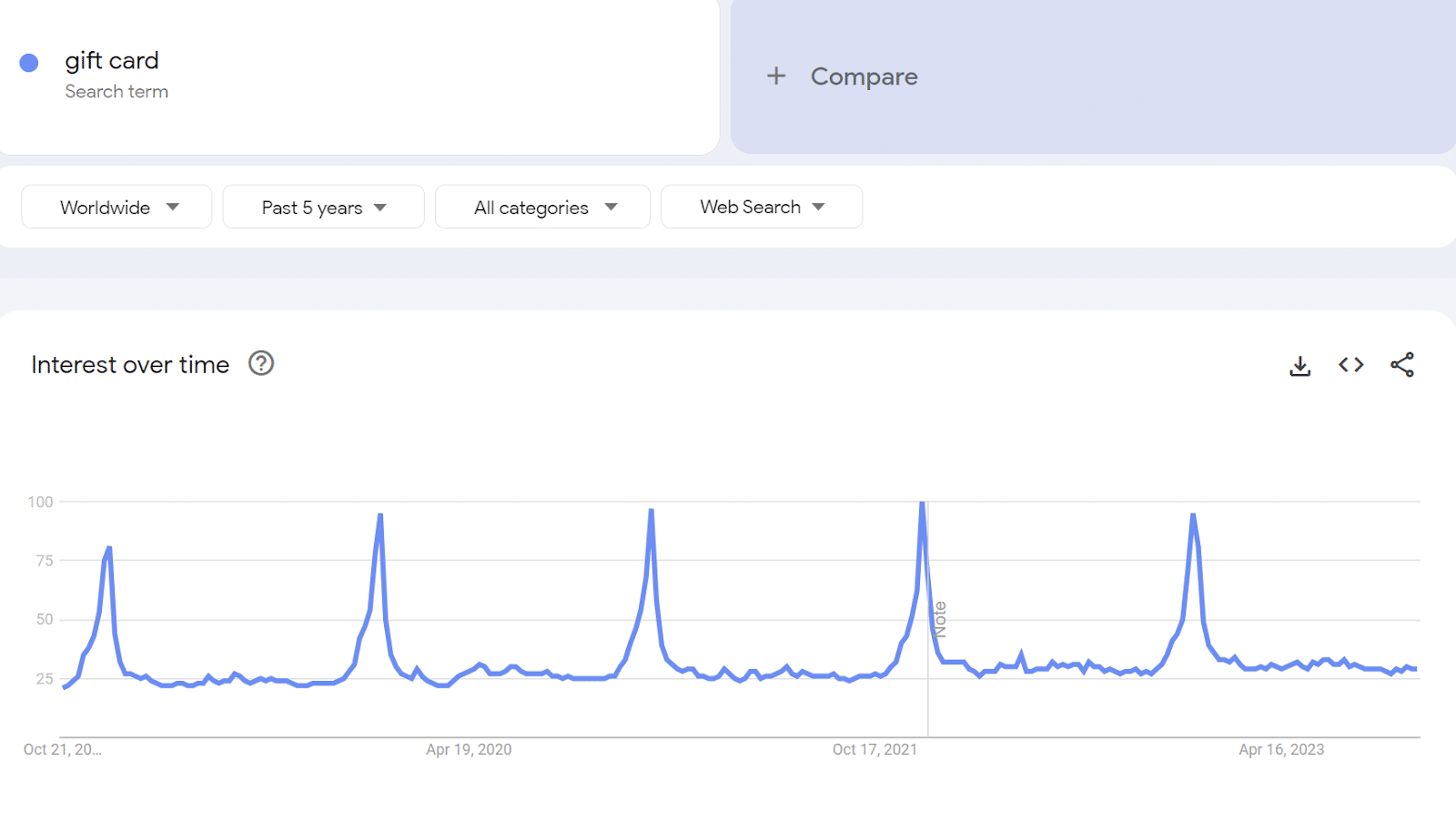
Let me give a few examples. Let's say you run a gift card business. You probably know that it’s a very seasonal market, and the customer journey is crazy fast.

People who are late buying Christmas gifts will Google “gift card” a couple of days before Christmas – and buy straight away.

Gift card - Google Trends

In that case, does it make sense to use DDA? Probably not.

Does it make sense to use Performance Max? Probably not, either.

Those prospects will use search mainly. That’s it. That’s the context driving your marketing strategy. It's not a one-size-fits-all best practice telling you to act blindly.

Here's another example: say you run a subscription-based business. Would it make sense to retarget Website visitors and saturate branded keywords?

Probably not. Those users will mostly be paying customers already.

So, would it make sense to use Performance Max with a bottom-of-funnel goal (something like a subscription)? Probably not, because Performance Max would go crazy on branded and retargeting campaigns. And those would not have great incremental value.

It's crucial for advertisers to critically assess PPC strategies. Running a data marketing agency, I emphasize that strategies shouldn't rely solely on data.

Don't feel obligated to strictly follow Google Ads or other ad networks' best practices, especially if their main pitch is being "AI-infused."

The post Google Ads best practices: The good, the bad and the balancing act appeared first on Search Engine Land.


via Search Engine Land https://ift.tt/hlnjHFz

The latest jobs in search marketing

Looking to take the next step in your search marketing career?

Below, you’ll find the newest jobs at brands and agencies in SEO, PPC and digital marketing – as well as positions we’ve shared in previous weeks that are still open.

Newest jobs in SEO, PPC and digital marketing

Director of Organic Marketing, Community Phone (Remote)

  • Salary: $130,000 to $160,000 (annual)
  • Own a budget and a revenue goal, set the path to hit it, and execute.
  • Secure our position as the owner of the landline phone service organic search space.

SEO Manager, Get It Recruit (Remote)

  • Salary: $106,000 to $149,000 (annual)
  • Develop a comprehensive global SEO strategy to enhance organic search rankings, encompassing programmatic and editorial content as well as technical enhancements.
  • Set and manage measurable goals to demonstrate year-over-year (YoY) increases in visitors and recommendations, aligning with targets.

Director, SEO Marketing, Sears Home Services (Remote)

  • Salary: $105,000 to $176,000 (annual)
  • Build and lead a high-functioning, analytics first team to support Sears Home Services executives,
  • Proactively support strategic planning and development of scalable, integrated marketing programs, messaging, and solutions that enable market growth.

SEO Manager, Aprio (Remote)

  • Salary: $90,000 to $125,000 (annual)
  • Develop and implement SEO strategies that align with the company’s marketing goals.
  • Conduct keyword research to identify the most relevant and popular keywords for the company’s target audience.

Technical SEO Manager, ClickUp (Remote)

  • Salary: $80,000 to $140,000
  • Develop and own a SEO roadmap in partnership with the engineering team, addressing bottlenecks to ensure timely delivery of system deliverables.
  • Take ownership of our current programmatic SEO initiatives and plan expansion methods.

Associate SEO Specialist, Pella Corporation (Remote)

  • Salary: $55,000 to $80,000 (annual)
  • Reviewing and analyzing sites for areas that can be improved and optimized
  • Track, report, and analyze local rankings and competitive sets.

More SEO jobs

GVP, Organic Growth, Gartner (Austin, TX)

  • Salary: $208,000 to $294,000 (annual)
  • Collaborate with GDM leaders to develop SEO strategies based on business goals, aligning each program with a broader SEO strategy and the GDM keyword ecosystem.
  • Implement SEO strategies to increase traffic to buyer sites (Capterra, GetApp, Software Advice, UpCity) through on-page techniques such as title and meta-tagging, indexing, keyword ranking overall site architecture and off-page techniques (link building, backlink profile, etc.) to get exposure while building trust and authority for our content.

Senior Director of SEO, Salesforce (San Francisco, CA)

  • Salary: $206,000 to $314,000 (annual)
  • Lead the conceptualization and execution of comprehensive SEO strategies aligned with overarching marketing and business objectives. Craft a strategic roadmap that encompasses technical SEO, content strategy, keyword research, and competitive analysis.
  • Orchestrate the technical facets of SEO, collaborating closely with our web development team to ensure flawless implementation of on-page and technical SEO elements. Monitor website performance, identify improvement opportunities, and lead initiatives to bolster site speed, mobile responsiveness, and crawl efficiency.

Vice President, Search Engine Optimization, CBS Sports (New York, NY)

  • Salary: $205,000 to $240,000 (annual)
  • Develop and carry out comprehensive SEO strategies to improve rankings, visibility, and traffic across all digital properties.
  • Lead in optimizing website content and meta tags for search engines, including on-page SEO techniques such as title tags, meta descriptions, header tags, and URL structures.

Director, Website & SEO, Dashlane (New York, NY)

  • Salary: $189,000 to $220,000 (annual)
  • Develop, manage and execute end to end customer experience on web and mobile.
  • Develop and execute an end to end customer journey experience on web & search, based on enterprise wide customer personas / segments.

SEO Director, Marketplace Partnership, Front Row (New York, NY)

  • Salary: $120,000 to $180,000 (annual)
  • Plan, develop and implement strategic development for SEO initiatives/campaigns, starting from onboarding and extending through post-launch and analysis stages.
  • Define and build SEO best practices based on clients’ objectives and market opportunity, using a mix of proprietary tools, analytics, and PPC data. Continue to develop the direction of our SEO offering along with the other SEO Leads, advancing our strategic capabilities.

Director Integrated SEO and SEM Manager, TIAA (New York, NY)

  • Salary: $115,000 to $160,000 (annual)
  • Works to support the development and implementation of digital marketing efforts to build and sustain presence in digital channels and to increase revenue and profitability.
  • Manages the creation, maintenance, and publishing of digital marketing content for both company and non-company websites and social media platforms, ensuring content and display support marketing initiatives to meet business goals.

Associate Director, SEO, Assembly Global (Baltimore, MD)

  • Salary: $110,000 to $125,000 (annual)
  • Own day-to-day interactions with enterprise SEO clients.
  • Manage client program workflow, including fixed deliverables and ad-hoc projects.

SEO Manager, Vanta (Remote)

  • Salary: $104,000 to $122,000 (annual)
  • Spearhead the development, implementation, and management of SEO strategies.
  • Conduct thorough SEO audits, competitor analyses, and keyword research.

Sr. SEO Manager, Adobe.com (San Jose, CA)

  • Salary: $101,000 to $183,000 (annual)
  • Define and implement a strategic content roadmap for Experience Cloud on the Business.Adobe.com blog.
  • A successful person in this role will have effective interpersonal skills, an understanding of intent frameworks and a real passion for SEO.

Senior SEO Marketing Manager, Remitly (Seattle, WA)

  • Salary: $100,000 to $124,000 (annual)
  • Collaborate with cross-functional teams to streamline the content production process. Ensure a continuous flow of high-quality content that helps customers make purchasing decisions.
  • Leverage external agencies and resources to achieve SEO goals and outcomes.

Web SEO Content Manager, Xylem, Inc, (Remote or NC, NY, IL, MA, NJ)

  • Salary: $95,000 to $125,000 (annual)
  • Develop and edit engaging, SEO-optimized content for our website and other digital platforms.
  • Ensure all content aligns with our brand voice, tone, and messaging guidelines.

SEO & Performance Marketing Manager, Amika (Brooklyn, NY)

  • Salary: $95,000 to $120,000 (annual)
  • Manage Performance Marketing campaigns to help acquire new customers and drive traffic towards our platform with a focus on paid tactics.
  • Improve audience expansion and customer lifetime value together with the aim of reducing acquisition costs.

Search Engine Optimization Manager, Restaurant 365, (Remote)

  • Salary: $90,000 to $120,000 (annual)
  • Plan, develop, and implement a successful SEO strategy.
  • Guide the content team through keyword research and organic search optimization.

Senior Search Data Strategist, Botify (New York City, NY)

  • Salary: $90,000 to $100,000 (annual)
  • Work closely with clients to understand their specific SEO strategy and build a success plan that meets their needs and objectives leveraging the Botify platform.
  • Meet individual client needs by configuring crawl and render settings, creating custom reports, and co-develop business logic to meet client specifications.

Senior SEO Copywriter, Marketplace Partnership, Fortress Brand (New York, NY)

  • Salary: $85,000 to $125,000 (annual)
  • Lead and inspire a team of one SEO Copywriter, providing oversight, guidance, and feedback.
  • Create high-quality, SEO-friendly copy aligning with brand voice, content briefs, and SEO analytics.

Sr SEO Specialist, SurveyMonkey (Remote)

  • Salary: $83,130 to $112,470 (annual)
  • Lead and execute advanced SEO strategies to elevate our organic search rankings and visibility.
  • Develop and execute effective on-page and off-page SEO strategies to improve search rankings and organic traffic.

Senior SEO Content Strategist, North Star Inbound (Remote)

  • Salary: $65,000 to $75,000 (annual)
  • Conduct keyword research to inform client strategy.
  • Ideate creative content ideas based on research of industry trends, keywords, competitor analysis, and trending topics.

SEO Specialist, Wonderist Agency (San Diego, CA)

  • Salary: $60,000 to $80,000 (annual)
  • Developing and implementing SEO strategies that increase rankings and organic traffic.
  • Developing monthly content strategies and adding content to WordPress and Webflow websites.

SEO Specialist, Wonderist Agency (San Diego, CA)

  • Salary: $60,000 to $80,000 (annual)
  • Developing and implementing SEO strategies that increase rankings and organic traffic.
  • Developing monthly content strategies and adding content to WordPress and Webflow websites.

SEO Content Specialist, LandrumHR (Remote)

  • Salary: $60,000 (annual)
  • Collaborate across departments to create innovative content ideas that accomplish strategic SEO objectives.
  • Perform keyword research including discovery and expansion of keyword opportunities.

SEO Specialist, Perrill (Minnetonka, MN)

  • Salary: $60,000 to $75,000 (annual)
  • Analyzing data using tools like SEMrush, Google Search Console, Looker Studio, and more.
  • Implementing measurement strategies through Google Analytics and Google Tag Manager.

(SR) SEO Analyst, Terakeet (Remote)

  • Salary: $58,000 to $88,000 (annual)
  • Executes competitive and market opportunity analyses as they relate to search intent, competitor niche saturation, backlink profiles, and SERP anomalies.
  • Performs keyword research for multiple segments of large enterprise websites, considering many strategic factors such as seasonality, search demand trends, and target audience intent.

SEO Specialist, Pure Visibility (Remote)

  • Salary: $58,000 to $65,000 (annual)
  • Work with the SEO director to perform in-depth visibility audits for new clients and compile the results along with prioritized recommendations.
  • Work with the SEO director to analyze and create action plans around common technical SEO components (canonicalization, sitemaps, crawl budget, schema, hreflang).

More PPC jobs

Director, Digital Media, Sega of America, Inc. (Irvine, CA)

  • Salary: $160,000 to $205,000 (annual)
  • Partner with Product Marketing, Consumer Insights and Business Intelligence to develop a deep understanding of gamers’ media consumption habits and decision-making biases. Analyze historical performance, seasonal trends and competitor innovations to hone media planning and briefing.
  • Lead the measurement and analysis of media plan performance, run AB test to drive and continually seek optimization opportunities to drive bit performance and learning renascence.

Head of Growth Marketing, DICE (Brooklyn, NY)

  • Salary: $145,000 to $160,000 (annual)
  • Creating and implementing a holistic data-driven business growth strategy to maximise lead generation, new customer acquisition, drive retention and identify new market opportunities, revenue streams, and areas for expansion.
  • Continuously evaluating and adjusting initiatives to achieve scalable and sustainable growth.

Director, Performance Marketing, ResortPass (New York, NY)

  • Salary: $140,000 to $160,000 (annual)
  • Directly responsible for the success of performance marketing at ResortPass.
  • Oversee and own the strategy, management and execution of Resortpass’ seven digit paid media budget across paid digital channels including Paid Social, Search, Influencer, Display and Affiliate.

Social Media Manager, Google Ads, YouTube Ads Marketing, Google (New York, NY)

  • Salary: $133,000 to $199,000 (annual)
  • Develop and manage the strategy and editorial content and calendars for all Google Ads social activity across YouTube, LinkedIn, and social media platforms.
  • Identify opportunities to collaborate on B2B and B2C initiatives with the Social Lab and YouTube consumer social teams.

Performance Marketing Manager, Good American (Los Angeles, CA)

  • Salary: $110,000 to $115,000 (annual)
  • Management of the paid search channel, including the day-to-day “hands on keyboard” responsibilities along with assisting in channel strategy.
  • Deliver on weekly/monthly/quarterly targets by performance marketing channel for sales and KPIs – deep understanding of conversion metrics and their impact on each other (CAC, ROAS, CVR, AOV).

Associate Director of Paid Media, Dotdash Meredith (Liberty, NY)

  • Salary: $96,000 to $120,000 (annual)
  • Oversee day-to-day operations of team of 2-3 specialists ensuring full delivery of our contractual obligations while delivering on performance KPIs and managing monthly spend in line with budgets.
  • Partner with Account Strategy, Revenue Operations and Ad Operations leadership to streamline operations and eliminate gaps.

Senior Social Media Analyst, adQuadrant (Remote)

  • Salary: $90,000 to $115,000 (annual)
  • Effectively audit an account for effective or ineffective implementation of best practices and strategies.
  • Proactively build relationships with platform partners, gain insights and recommendations which result in an increase in efficiency or scale. Also, proactively communicates when partners can improve the support provided to our team.

Paid Social Manager, Lionsgate (Santa Monica, CA)

  • Salary: $90,000 to $100,000 (annual)
  • Plan innovative paid social media programs for brand and series marketing with the digital marketing team to ensure development and execution align with overall campaign objectives.
  • Strategize with the Director of Paid Social on planning an integrated campaign that includes paid auction media and direct buy partners.

Manager, Paid Media Branding, Dow Jones (New York, NY)

  • Salary: $65,000 to $200,000 (annual)
  • Create an effective strategic framework across digital media channels including Google, Facebook/Instagram, Twitter, TikTok etc. to drive awareness and consideration of Dow Jones’ brands.
  • Optimize strategies for each channel to improve performance and ensure the KPI goals are met.

Paid Media Strategist, SmartBug Media (United States / Remote)

  • Salary: $60,000 to $80,000 (annual)
  • Developing, implementing, and leading the account’s paid media strategy for various channels including Google, Microsoft, Amazon, YouTube, LinkedIn, Facebook/Instagram, and other third-party ad platforms.
  • Defining important metrics for paid media performance.

Media Manager, Paid Search, Hawke Media (Remote)

  • Salary: $60,000 to $80,000 (annual)
  • Support the day-to-day account management of Paid Search clients and take full ownership of all activities.
  • Develop, execute, and manage day-to-day Google Ads and Bing strategy, tactics, & execution.

Other SEM and digital marketing jobs

Vice President, Creative & Strategic Marketing, NBCUniversal (San Francisco, CA_

  • Salary: $165,000 to $180,000 (annual)
  • Serve as a relentless brand leader, overseeing the development and execution of impactful brand positioning, storytelling, and strategic customer-centric messaging.
  • Oversee cross-platform marketing and go-to market strategy across owned, earned, and paid media.

Director, SEM, LegalZoom (Glendale, CA)

  • Salary: $144,000 to $207,000 (annual)
  • Develop and implement strategic paid search campaigns across multiple channels (Google Ads & Bing Ads) that align with business goals and drive revenue growth.
  • Lead and manage a team of paid search Managers/Specialists to execute on paid search strategies and campaigns.

Director, Growth Marketing, Loop (Remote)

  • Salary: $137,600 to $206,400 (annual)
  • Lead and develop global demand generation campaign strategy plans, outlining key demand themes, messages, and offers and channels for promotions within defined monthly, quarterly, and annual cycles.
  • Oversee various marketing initiatives, encompassing both inbound and outbound strategies, with a focus on campaign integration, database management, email marketing, events, co-marketing, targeted nurture programs, account-based marketing, search engine optimization, paid search, and sales pipeline acceleration.

Senior Marketing Manager, Paid Social, Who Gives A Crap (Los Angeles, CA)

  • Salary: $130,000 to $140,000 (annual)
  • Help acquire, retain and grow our active customers by creating meaningful, delightful and impactful paid marketing moments that inspire action and align with our values and strategic focuses.
  • Leverage technical expertise and data acumen to lead the team in data-driven decision-making, including developing a rigour around a scorecard of KPIs to keep tabs on key performance trends.

Digital Media Manager, Verizon (Basking Ridge, NJ)

  • Salary: $128,000 to $239,000 (annual)
  • Designing and implementing executive social media strategy to align with business goals in support of the overall brand and Verizon’s select C-suite reputation.
  • Creating, editing, publishing and sharing engaging content daily (e.g. original text, photos, graphics, videos and news).

Paid Media Manager, Fireblocks (New York City, NY)

  • Salary: $110,000 to $150,000 (annual)
  • Lead the implementation of Fireblocks paid marketing campaigns on Google Ads (PPC) and 6sense.
  • Examine correlations between prospecting activities, revenue, and budget.

Digital Marketing Manager, OpenX (New York, NY)

  • Salary: $110,000 to $130,000 (annual)
  • Oversee calendar of campaigns and strategically align them to OpenX’s priorities and key moments.
  • Paid Media & Social: Manage paid media campaigns across LinkedIn and other paid channels. Manage OpenX’s organic social presence across LinkedIn, Twitter, Instagram and more as needed.

Senior Digital Director of Marketing, Apex Leaders (Boise, ID)

  • Salary: $105,000 to $135,000 (annual)
  • Data Driven Strategy Development: Develop and execute a comprehensive demand generation strategy deeply rooted in data-driven insights, to achieve results. You will align strategies with the company’s quarterly and annual goals, private equity target market, and digital buyer personas, continuously testing and optimizing to improve ROI.
  • Digital Campaign Testing & Management: Plan, execute, and optimize digital marketing campaigns with a strong emphasis on testing various elements, including ad creatives, inbound source, messaging, and landing page designs. Leverage A/B and multivariate testing methodologies to refine campaigns. Current channels include digital advertising, content marketing, email marketing, SEO/SEM, social media, and events.

Associate Manager, Online Marketing, Match (West Hollywood, CA)

  • Salary: $80,000 to $100,000 (annual)
  • You will create, manage, and analyze online marketing campaigns across paid digital media platforms including display, search, and social to ensure acquisition and conversion goals are met.
  • You will execute digital marketing campaigns including A/B testing, campaign management and optimization, ad copy and creative testing, etc.

SEM/Performance Marketing Specialist, VisitorsCoverage Inc (Santa Clara, CA)

  • Salary: $72,000 to $92,000 (annual)
  • Build, scale, and optimize performance marketing channels including but not limited to, Google Ads, LinkedIn, Facebook, etc. to support the company’s business objectives, including brand awareness, demand generation and sales acceleration.
  • Efficiently manage and deploy budget with the appropriate media mix to garner the best results.

Are you looking to hire?

You can submit your job listing details here for free. Please include:

  • Job title.
  • Company.
  • Job listing URL.
  • Date when the job listing closes.
  • Where the position is located (e.g., remote, city, country).
  • Salary range (we will not include job listings in this article unless they include this).

Note: We update this post weekly. So make sure to bookmark this page and check back.

The post The latest jobs in search marketing appeared first on Search Engine Land.


via Search Engine Land https://ift.tt/hn3WEHG

8 surprising social video trends

Halloween is traditionally the perfect season to anticipate unexpected shocks.

But eight surprising social video trends should astound even the most unflappable digital marketers. 

Firefly Seven surprising social video trends with a Halloween theme

1. The number of creators on YouTube is exploding

YouTube.com is the second most visited website in the U.S. and worldwide, behind only Google.com, per Similarweb and Semrush’s data.

So, if you were a content creator planning to go trick-or-treating, you’d tell all your friends, “They give out more candy on YouTube than any other social video platform.”

This favorable word-of-mouth tells a surprisingly scary story, too.

  • Last year, 15.4 million accounts uploaded 696 million videos to YouTube from Oct. 16, 2021, to Oct. 15, 2022. These videos got a total of 23.2 trillion views and 742 billion engagements.
  • This year, 25.4 million accounts uploaded 774 million videos to YouTube from Oct. 16, 2022, to Oct. 15, 2023. These videos got a total of 23.9 trillion views and 747 billion engagements.

So, the number of creators on YouTube has exploded and the number of videos is up, too! But the total number of views and engagements has remained relatively flat year over year.

This means 64.9% more creators are now competing for roughly the same number of views and engagements. Or as savvy trick-or-treaters going door-to-door on Halloween might yell at their friends, “We gotta move faster before they run out of candy.”

Hey, this is a real problem. That’s why YouTube provides tips for dealing with creator burnout.

But this has an impact on digital marketers, too. It means we must work harder – or smarter – to capture our audience’s attention. 

For example, you might want to check out YouTube’s new Spotlight Moments, an AI-driven packaging technology that automatically identifies the most popular, relevant videos, making it even easier for us to own the moment around key events when viewers are most engaged.

Dig deeper: 5 new YouTube features coming soon to help creators

2. How long should a social video be?

“Short-form content empowers creators to win views and reach new audiences, but new data shows that many audiences prefer a slightly longer format,” according to Tubular’s report, H2 2023 Social Video Trends.

In 2022, TikTok increased its video length capabilities to compete with longer-form video platforms. Tubular data found that 61-180-second videos earn the highest growth rates per the number of uploads on TikTok, making it the optimal video length to drive growth.

Although videos 1-60 seconds long still win the most views, the report said, “growth rates for this time frame are in decline.” Meanwhile, videos 61-180 seconds long and 181-600 seconds long “show a positive growth in views.”

Dig deeper: Video content guide: Why you should start creating videos now (plus examples)

3. Facebook no longer needs to whistle past the graveyard

Facebook use among teens had dropped from 71% in 2014-15 to 32% in 2022, according to a Pew Research Center survey.

Meanwhile:

  • 95% of American teenagers ages 13 to 17 used YouTube.
  • 67% used TikTok.
  • 62% used Instagram.
  • 59% used Snapchat. 

And in July 2022, Facebook’s parent, Meta, reported its first-ever year-over-year decline in ad revenue.

But Facebook restructured its main feed into a “discovery engine” for video content, and today, it appears that the social video platform no longer needs to whistle past the graveyard.

Facebook.com is currently the third most visited website in the U.S. and worldwide, per Similarweb and Semrush.

Tubular Labs data also found that 5.3 million accounts uploaded 400 million videos to Facebook from Oct. 16, 2022, to Oct. 15, 2023. These videos got a total of 11.8 trillion views and 551 billion engagements.

By comparison, 4.5 million accounts uploaded 311 million videos to Facebook from Oct. 16, 2021, to Oct. 15, 2022. These videos got a total of 12.4 trillion views and 473 billion engagements.

So, 17.8% more accounts are now publishing 28.6% videos on Facebook. Although views are down 4.8%, engagements are up 16.5% year over year.

Digital marketers can expect more developments from Facebook:

“This is just the beginning. We’ll continue developing more tools for creators so they can express themselves, build an audience and earn money, along with the discovery and personalization features that give you more control over your experience.”

– “Video on Facebook Keeps Getting Better,” July 17, 2023  

4. What music are you using in your latest social video?

Many moons ago, music on social videos was limited to “music videos.” 

Then, in 2014, “trackvertising” became a trend. That’s when a brand and musical artist co-release a video, both a musical track and an ad. 

For example, Activia, a brand of yogurt owned by Groupe Danone, collaborated with Shakira, a Colombian singer and songwriter, to create “Shakira – La La La (Brazil 2014) ft. Carlinhos Brown.”

Today, music is as closely associated with social videos as spooky sounds are with Halloween. 

Tubular makes the eerie claim, “That’s right – music and social video are synonymous.”

So, creators and brands should begin with music when brainstorming their content strategy. To help with that process, Tubular examined the top 50 TikTok sound trends in the first half of 2023.

At the top of their list were Hip-Hop, Rap, and R&B, the most popular music genres both by number of sounds 13 of 50) and total views (7.8 billion). 

And part of this trend was older songs, which were resurfacing. As Tubular noted, “The sweet spot of songs making a resurgence are songs released in 2010-2014.”


Get the daily newsletter search marketers rely on.

Processing…Please wait.


As you know, bobbing for apples involves catching an apple in a tub filled with water – with your teeth. Why? Because using your hands would be cheating.

Well, Instagram stopped providing Tubular with access to its data for views in November 2020. However, it continued to provide access to the number of accounts using the social video platform, videos they published, and engagements they got. 

Why? I don’t know, it's a mystery.

Nevertheless, that’s what makes catching social video trends on Instagram like bobbing for apples.

Still, 4.3 million accounts uploaded 278 million videos to Instagram from Oct. 16, 2021, to Oct. 15, 2022. These videos got a total of 907 billion engagements.

And 4.1 million accounts uploaded 297 million videos to Instagram from Oct. 16, 2022, to Oct. 15, 2023. These videos got 1.2 trillion engagements (with a “t”).

So, the social video platform has lost 4.7% of its creators in the past year, but the remaining ones have created 6.8% more videos, which have received 32.3% more engagements.

Now, that’s a trend you can sink your teeth into.

6. On TikTok, ChatGPT isn’t considered a scary Halloween costume  

ChatGPT was launched on Nov. 30, 2022 by OpenAI. So, this is the first year that the chatbot could be considered by anyone interested in wearing a scary Halloween costume.

But Tubular data for the first half of 2023 indicates that TikTok viewers are more interested in finding hacks and tips about using ChatGPT and integrating generative AI technology into their daily lives. 

If you look at the percentage of views on this topic on TikTok, then you’ll be stunned to see:

  • 30% come from the Business category.
  • 24% come from School.
  • 19% come from Memes & Comedy.
  • 17% come from Software Engineering.
  • 7% come from Marketing.
  • 4% come from Art.

This lack of fear about chatbots is reflected in the views of education hashtags about ChatGPT on TikTok:

  • #school 140.5 million.
  • #college 130.3 million.
  • #university 92.7 million.
  • #essay 84.1 million.
  • #student 73.0 million.
  • #highschool 62.3 million.

So, it appears that TikTok viewers have taken the advice of Nvidia founder and CEO Jensen Huang, who said in a commencement address back in May: 

“While some worry that AI may take their jobs, someone who’s expert with AI will.”

7. Accounts and videos on X, formerly Twitter, are imploding

Meanwhile, in another part of the social video landscape, everyone’s watching a horror movie.

Elon Musk completed his acquisition of Twitter on Oct. 27, 2022. So, theoretically, we could now use Tubular Labs data to compare the performance of social videos on X, formerly Twitter, over the last 365 days to the same period before he purchased the platform.

But X appears to have stopped providing Tubular Labs with access to its data on July 1, 2023. 

Nevertheless, 5.6 million accounts uploaded 145 million videos to Twitter from Oct. 27, 2021, to June 30, 2022 – before Musk bought the platform. These videos got a total of 602 billion views and 27.5 billion engagements.

In contrast, 4 million accounts uploaded 122 million videos to Twitter from Oct. 27, 2021, to June 30, 2022 – after Musk bought the platform. These videos got a total of 751 billion views and 35.6 billion engagements.

So, the number of accounts and videos was imploding on X while the number of views and engagements was growing on the platform.

Nevertheless, you might want to use Follower Audit, Twitter Audit, or Circleboom to identify bot and fake followers of any public account. 

Mashable and Travis Brown took a close look at Musk’s more than 150 million followers on X, formerly Twitter, on Aug. 18, 2023.

They found that around 42% of Musk's followers – over 65.3 million users – had zero followers. Moreover, over 72% of Musk's followers had less than 10 followers on their accounts.

So, the social platform increasingly looks like a haunted house that’s perceived to be inhabited by disembodied spirits of the deceased. This means digital marketers should start looking for an exit – if they haven’t left already.

Now, many industry observers saw this coming from a mile away. So, maybe the implosion of X, formerly Twitter, isn’t a surprising trend.

And I don’t want you to feel like I’m handing out the equivalent of Candy Corn, a polarizing Halloween candy, or Circus Peanuts, ranked as the worst Halloween candy in 2022 and 2023.

So, let me share one more surprising social video trend.

8. Reach more eyeballs by posting news videos late at night

Most creators in the U.S. news media post their videos during the day. But Tubular data for the first half of 2023 was shocked to find that news-related videos posted from 10 p.m. to midnight Eastern won the most views within the first 24 hours.

So, if the U.S. news media wants to reach more eyeballs, they need to start posting stories when their viewers have the time and interest to watch them – after they’ve gotten home from work, had dinner, and put the kids to bed.

The U.S. news media should also re-evaluate their assignment editors. 

Among all the U.S. news media on TikTok in the first half of 2023, videos about the missing Titanic submersible received more views than all the presidential content combined. 

On the other hand, news cycles are fleeting. However, evergreen content can live forever on social video platforms.

For example, Inside Edition demonstrated stronger staying power than top news competitors by posting content that could outlive the 24-hour news cycle.

And the publisher received nearly three times more views on YouTube videos originally posted 1 to 2 years prior than all the other creators combined.

Dig deeper: Top video marketing trends for 2023 and beyond

Attracting audience attention with social videos

As the social video landscape continues to transform, digital marketers and creators must remain vigilant, seizing opportunities and staying ahead of the curve to reach and engage their target audiences effectively.

The post 8 surprising social video trends appeared first on Search Engine Land.


via Search Engine Land https://ift.tt/v3slf4y

Thursday, 26 October 2023

Reassessing the role of links in SEO: What data tells us

The debate over the significance of links has been a recurring theme in SEO.

Recently, Google’s Gary Illyes has once again ignited discussions around the topic when he said that “people overestimate the importance of links,” and it hasn’t been in the top three ranking factors for some time. 

Such statements from Google have been made in the past, prompting SEO professionals and businesses to reconsider their strategies. 

This got me thinking about how essential links really are today. What would the data show? 

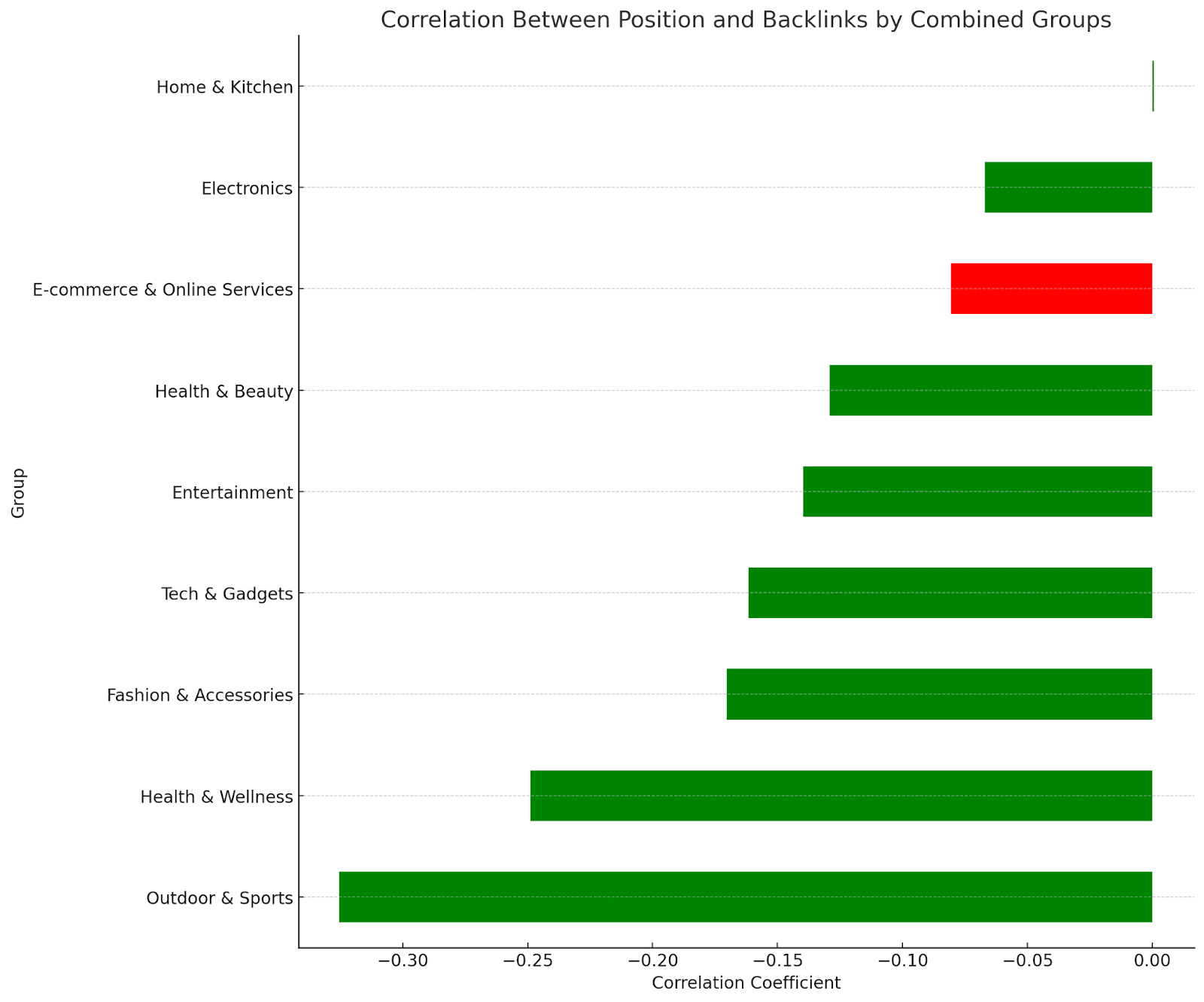
To find out, I analyzed 100 random keywords spanning various categories, collecting data on the top 100 ranking websites, including referring domains and backlinks. This comprehensive dataset consisted of over 10,000 rows of URL ranking data. 

It’s important to note that correlation does not imply causation, especially considering Google’s stance on the ever-evolving nature of ranking factors. However, digging into the data can give us a sense of where links are more important as a category. 

Data analysis and key findings

Considering Illyes’s comment, I initially expected we would find a moderate link between backlinks and rankings, but nothing that suggested this was the key to improving rankings.

Probably for the first time in a while, the data aligned with this hypothesis. 

To conduct this analysis, I divided the 100 keywords into specific categories: Electronics, Health and Beauty, Entertainment, and more.

In correlation analysis, a higher value indicates a stronger relationship between the two variables, while a value closer to zero signifies a weaker relationship. 

In the context of our analysis, where the goal is to achieve the top rank, an ideal score is -1. This means that as the number of backlinks increases, the ranking “decreases” or moves closer to the number one position.

Here are the takeaways from the data:

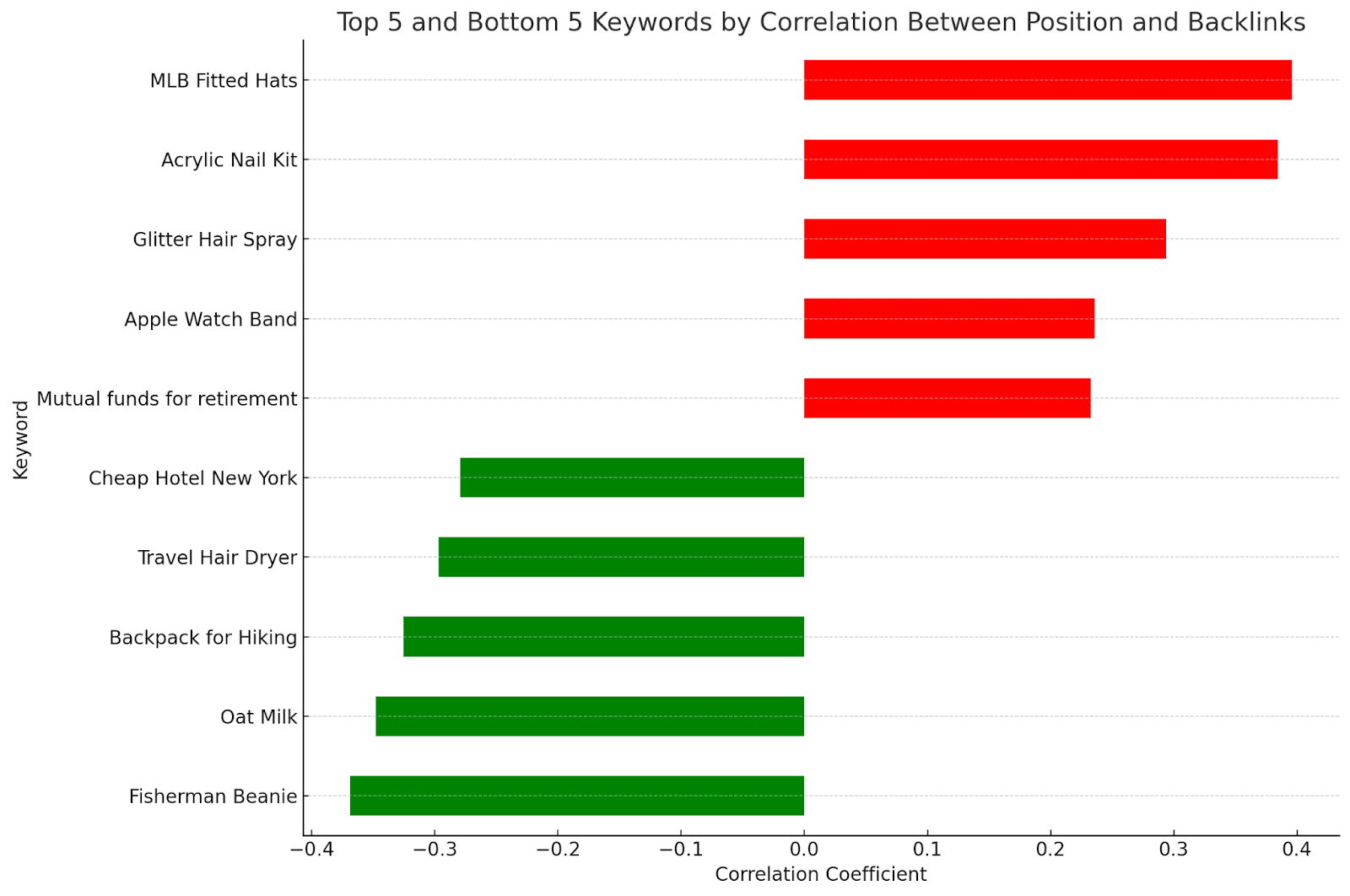
  • No keyword grouping or individual keyword was greater than -0.4. This means no data set was super highly correlated.
  • There were keywords and groups that, when the number of links increased, rankings actually decreased (these would be positive correlations given the rank numbers get higher). However, again, nothing was greater than 0.4. 
  • The highest correlation groupings were Outdoor and Sports and Health and Wellness
  • The groupings where links drove a decrease in rank were Home and Kitchen and Ecommerce and Online Services.
  • At a keyword level, “fisherman beanie” and “oat milk” showed the greatest correlation, while “MLB fitted hats” and “acrylic nails” were the lowest. (The graph below that shows the keyword level only graphs the top and bottom five.)

Get the daily newsletter search marketers rely on.

Processing…Please wait.


Knowing that the correlation coefficient aligns with Google’s point, what should we do with this information? How should we alter or think about your own brand’s link profile? 

Here are three takeaways and recommendations from this data set for your SEO strategy.

While Google emphasizes that links aren't as powerful a ranking factor as in past years, they remain a valuable signal. 

Consider them an indicator of user and website endorsement for your content and products. If a specific blog post or product garners a substantial increase in links, it signals user appreciation. 

Redirect your efforts accordingly – create more content or products in that area or intensify your promotion. 

These links provide essential intent-based data for optimizing your time, even if it doesn't always translate into higher rankings.

2. You should always be evaluating your competition and specific data sets

With over 10,000 data points, our dataset holds significance, but it's not tailored to your brand or industry. Use this article as a guide to analyzing your own data for insights. 

Examining your top 100 keywords will clarify your competitive landscape, enabling more focused strategy development. 

If other brands in your space have significantly more links, it signals a challenge, but remember, links aren't the sole driver of rankings. Instead of feeling overwhelmed, use this data to inform and refine your strategy.

3. The fundamentals have been, and will always be, the North Star for organic search 

SEO's original objective is to boost brand rankings, a goal that remains relevant today.

However, the emphasis has shifted toward delivering a great user experience, evident in Google's E-E-A-T framework: Experience, Expertise, Authoritativeness and Trustworthiness.

E-E-A-T underscores the significance of user experience and values. They don't advocate link acquisition as the primary strategy but instead highlight the importance of building a website that enhances the value of your goods or services for end-users.

This user-centric approach should be your guiding light.

I found this dataset interesting as it spans various industries and consistently suggests that while links matter, they are not the sole determinant.

I'll closely monitor how the data evolves with large language models incorporating more links, which could reshape link values and website visibility. 

It's an exciting time for search, marked by innovation, and data will be our compass to gauge the changing landscape. I'm eager to see how links continue to influence rankings in this next phase.

The post Reassessing the role of links in SEO: What data tells us appeared first on Search Engine Land.


via Search Engine Land https://ift.tt/OXBsiIt

How to improve PPC campaign performance: A checklist

With the busy season upon us, you want your PPC campaigns to be in the best shape possible.

Whether you’re getting great results, struggling to perform or somewhere in between, below is a checklist of 13 features to help set your campaigns up for success.

1. Align and reassess client objectives 

Campaign performance is only as good as its ultimate objective. Just because you see year-over-year (YoY) revenue growth or improved return on ad spend (ROAS) doesn’t mean you can get the party poppers out. 

What is the client’s priority objective? Has this changed? Is it still revenue growth? Or has it shifted more toward lifetime value (LTV) or profitability? 

This is the first point because it’s the most important point. Get this right, and everything else will follow. 

2. Enable Google Ads conversion tracking

In the age of AI and automation, accurate data tracking is more important than ever. Without the correct data, what are we even doing here? 

Google Ads conversions are preferred over Google Analytics imported conversions because the former provides better integration (more conversions), cross-device or view-through conversion capabilities and advanced features. 

Dig deeper: PPC Guide: Conversion tracking and what you can measure

3. Layer on Enhanced Conversions

Once you’re happy with the Google Ads tracking foundations, go to the next step and layer on Enhanced Conversions

This feature helps improve the accuracy of Google Ads tracking by sending hashed first-party conversion data from your website to Google in a privacy-safe way.

Google boasts it can increase your conversion coverage by 15% (I’ve seen a few numbers here, so I’m going for average).

Consent mode is similar to Enhanced Conversions, as it’s another feature to improve your conversion coverage. With third-party cookies on the way out, conventional Google Ads tracking struggles to track all conversions. With this turned on, Google has the capability to use consent signals to model and recover any lost conversions.

Dig deeper: A PPC guide to permission-based audiences

5. Use offline conversion tracking

Offline conversion tracking (OCT) solves my most common problem with my lead gen clients. Looking at our PPC reports, lead numbers are good, but the client’s feedback is that the quality is low. 

What else am I supposed to do? This feature enables you to give a specific value to a lead.

This can be done by manually importing data directly into Google from your CMS or through integration options for automatic imports. 

Successful implementation will then give you the ability to leverage value-based bidding strategies to take full advantage of the advanced data.

Dig deeper: Offline conversion tracking to boost lead gen strategies

6. Configure dynamic remarketing parameters

While an afterthought for most advertisers, properly configuring the dynamic remarketing element of your Performance Max campaigns will show the right products to users, enhancing campaign performance. 

It’s worth checking your data sources in your audience manager to see what is and isn’t configured. “Id” or “Ecomm_prodid” are the big ones here and need to be getting hits.

I know a lot of the tracking implementation best practices are outside the majority of PPC marketers’ comfort zones. 

Have limited access to developers to help you? I’d highly recommend the Conversion Tracking Mastery course from Miles McNair and Bob Meijer over at PPC Mastery. They go into detail on how to implement all of the above.


Get the daily newsletter search marketers rely on.

Processing…Please wait.


7. Optimize ad creative 

While we’re now in a Responsive Search Ads (RSAs) era, don’t overlook your ad creative. Try to keep things refreshed. 

Use the Ad strength feature as a basic guide, which will focus on a combination of relevancy and uniqueness in the ad copy, more from a mechanical viewpoint. 

Layer on some creative messaging to stand out from your competitors, too. Keep an eye on individual title and description performance within the Asset detail report (linked just below each Search ad), where Google highlights the best and worst performers. Swap out the bad performers for new variations of the best.

At a broader level, test out two or three variations in each ad group; one with no pins and the others using a mixture.

Google will optimize its RSA copy to get the best CTR, but sometimes, that CTR doesn’t mean a higher conversion rate or ROAS.

So, even if you generally trust Google to show the best copy and ads, keep that in mind and continue to test.

Dig deeper: Why strong Google Ads creative is THE priority for advertisers

8. Embrace broad match 

Two or three years ago, the thought of including broad match in this checklist would be laughable, but here we are. 

Combined with smart bidding, using broad match is a very effective way to scale your campaigns for success. 

Personally, I would still start off any new campaign with a mixture of phrase and exact match, but when a campaign has enough conversion data to utilize (30 in 30 days is a good place to start), start testing broad match variations. 

Just don’t forget to keep an eye on those search terms and look to bulk them out as much as you can before using broad.

9. Run campaign experiments

Experiments are a personal favorite of mine, and clients love them. I regularly A/B test different landing pages, bidding strategies, broad match variations and ad creative using this feature. 

They are quick and easy to set up within the Google platform and will keep your campaigns on their toes. 

The important thing to remember is to give them time. Google recommends a six-week period plus a conversion cycle, so the time lag is considered. When analyzing performance, bypass the first two weeks (learning period) and focus on the next four weeks. 

When setting up the custom experiment, you will be asked your two primary objectives.

Once the experiment has started, you can keep track of how things are going with the experiment summary report, which breaks the A/B test into a base and trial arm, so you can monitor the statistical significance of the main KPI (Again, clients love this!).

If you are a data nerd, this is the place to be.

10. Test asset groups (for Performance Max campaigns)

It's not strictly the A/B testing setup we just discussed, but it's essentially the same concept. 

Create multiple asset groups targeting the same shopping products but test different assets, audience signals, landing pages and so on. 

This is recommended before segmenting your asset groups further into different categories or branded assets. Get the fundamentals right first before expanding.

11. Test Performance Max vs. Shopping campaigns

People are still unsure about Google's golden goose, so much so that there has been a recent increase in standard Shopping adoption. 

Performance Max is certainly not perfect, and although Google continues to roll out the upgraded features, it’s not for everyone. To see if this is the case for your products, run both campaign types against each other within Performance Max experiments. 

12. Consolidate campaigns

Single-keyword ad groups (SKAGs) are no longer your friend. Simplifying your campaign structure is another secret key that will unlock the power of success. 

Smart bidding isn’t as efficient with multiple campaigns or ad groups with limited keywords in each. It likes its consolidated structures with centralized conversion data to sink its teeth into. 

This is because our Search ads now have so many more copy variations than they used to (15 titles compared to only three pre-RSA).

At the same time, increased broad match coverage and phrase/exact match targeting expansion make it nearly impossible to contain specific search terms with an expansive structure. 

So, if you can’t beat them, consolidate them!

Dig deeper: The Hagakure method for Google Ads management

13. Consider running Microsoft Advertising campaigns

Although some of the above can (and should) be actioned in Microsoft ads, I feel the need to give them a special mention as the little brother to Google. Microsoft advertising is often overlooked because of its smaller scale than Google. 

I often see better results on this platform because less competition means smaller than average CPCs in many verticals. Now, this isn’t as pronounced as it was a few years ago, but it’s still there to be taken advantage of. 

It is far from perfect (its smart bidding and Performance Max offerings are less superior to Google’s). Still, because of its first-to-market AI offering, the platform is increasing in popularity. 

The little brother is growing up fast, and 2024 could be a big year for them, so don’t miss out on the opportunity it brings.

Maximizing your PPC campaign performance: 13-point checklist

Incorporating these strategies and regularly reassessing your campaign's performance will help you stay competitive and make the most of your PPC efforts. 

Keep in mind that the digital advertising landscape is ever-evolving, and adapting to new trends and technologies is crucial for long-term success.

The post How to improve PPC campaign performance: A checklist appeared first on Search Engine Land.


via Search Engine Land https://ift.tt/kndm2TC